Showing posts with label KaBoom. Show all posts

Monday, July 03, 2017

Light Loads can Explode Page: Of interest to those who load their own ammo

Light Loads can Explode Page:

NEVER, NEVER, mix fast burning pistol powders like 2400 with large volume cases without some sort of overpowder wad, for if you do, you too could experience a debacle.
I have not mentioned this for several years, although I'm away I have written about this strange and complicated phenomena.

Using very light powder charges in high-capacity cartridges may, under specific and bizarre circumstances, subject your firearm to a loud, disconcerting, and very expensive KaBOOM! moment.

Rather than to attempt to explain it, I direct your attention to the link at the top of this page.

(Essentially, instead of a steady burn as the ignition works its way through the powder column ... ALL of the powder charge ignites "all at once", which presents a dramatic pressure spike beyond the usual.    Your firearms may very well not be sufficiently sturdy to resist this PRESSURE SPIKE!)

But don't take my word for it.  Go, RTWT!

PS:  Again, I highly recommend The Reloading Pages of M.D. Smith


Friday, April 14, 2017

The comments are sometimes more interesting than the article! (Another KABOOM! Article)

Here's the original article:

POTD: Watch Your Hands When You Unload And Show Clear - The Firearm BlogThe Firearm Blog:

Here's a typical comment:
 A shooter was unloading his handgun when this happened. From what Scott relayed to me, was that the shooter cups the ejection port to catch the round to save time from picking it up off the floor. Now to clarify, this was not a malfunction. It was not a FTF and the primer was never struck. What happened was that during the unloading process the shooter’s hand covers the ejection port. The round most likely ejected into the hand but since the hand was so close to the ejection port it got caught between the slide and barrel.
(The author of the comment obviously intended to say "... the primer was never struck by the firing pin".)

Here's a much more ... atypical ... comment:

I saw that happen at a match I was ROing, the guy covered the ejection port as he was unloading and either the ejector or the edge of the slide creased the primer enough to cause it to go off. The case blew out the bullet got a crease in the nose from the barrel hood and he got one piece of shrapnel that went all the way thru his pointer finger and a piece stuck in his thumb. I was the one that took him to urgent care but despite the flesh wound, he received no lasting injuries. It was an STI 2011 the only damage it got was the extractor spring broke.
In the 30+ years since I started shooting IPSC, I've never seen anyone break the extractor spring on an STI, model 2011.      In fact, I've never seen a STI 2011 with an "extractor spring", although I've had occasion during an IPSC match to take my STI to the safety are and 'retune' the extractor using three rocks as a vice and a hammer.   But that's another story, and one I've told too many times.

---

Here's another one:
Looks as though the extractor hit the primer from the marks on the case, not the slide port itself. I too have done this technique at the range clearing a malfunction but always push the slide stop up to lock the slide open at the same time while turning the pistol to the side.
Again, I fail to understand how the extractor can work itself out of the extractor well in the slide and allow the pistol to continue firing/

I suspect that the authors of these comments were not referencing an STI 2011.  In the second example, it's possible that the author cited the 'extractor' when he meant to say the "ejector'.

UNDER THE FOLD: 
As much as I hate to have to explain a joke: for those who are not familiar with the construction and nomenclature of the 1911-style semi-automatic pistol ... an explanation of why I find these comments amusing can find the technical details.

Tuesday, October 25, 2016

Sunday, April 10, 2016

Haven't they suffered enough?

Kerry Visits Hiroshima Memorial Seven Decades After A-Bomb - NBC News:

Secretary of State John
Kerry along with foreign ministers of G7 nations laid a wreath at an altar inside the Hiroshima Peace Park Memorial, paying tribute to World War II atomic bomb victims as the highest-ranking U.S. official ever to visit the memorial.

Oh, Krap!

I know they did that whole "Pearl Harbor" thing, but wasn't it enough that we paid them back with A-bombs at Hiroshima and Nagasaki?

Now we've tripled-down on them with the K-Bomb!

Oh, the humanity!


Wednesday, February 10, 2016

"Don't put that on the f*ckin' film, holy shit!"

Uncut Travis Haley Negligent Discharge:
Posted by: ENDO-Mike February 8, 2016

 I was getting tagged dozens of times in a 5 second clip of this video on Instagram.  I had no idea what the context was since the clip was so short, so I gave Travis the benefit of the doubt initially.  In this full video we see him demonstrating pushing his index finger on the magazine release at 1:46 when it slips off and hits the trigger which fires a round off.  Embarrassing?  Sure.  No one died and hopefully he learned from the incident.  What else can a person do right?  I’ve never had an accidental or negligent discharge, but I also don’t handle firearms day in and day out, and manipulate loaded firearms in front of cameras while talking and demonstrating different things.


 TOO MUCH TO SAY .. I don't know where to start!

Okay, here's a place to start:
The only 'safe place" to put your trigger finger when you have no intention to shoot is along the receiver above the trigger group.

When I saw the video and heard "Haley" say he would put his finger inside the trigger guard, but in front of the trigger .. or rest it on the magazine release housing (in front of the trigger) but "put tension on the trigger finger" I knew that was a recipe for disaster.   It made me cringe to watch it.

"Disaster" is defined as ND (Negligent Discharge).

Saturday, August 08, 2015

Dangerous Dan: The Man Who Would Not Quit

Everybody liked Dan.

But things happened to him.

I met Dan during my first year of shooting IPSC matches ... back when they had only three Divisions; Stock, Open, and Revolver.   And nobody was really sure what constituted an "OPEN" gun, because we rarely saw any that year.


Dan was an 'older' gentleman (probably 55 or so .. which age range I would now consider 'not older'), and he was an experienced competitor.  And he knew more about the rules of competition than I did.

Not that he had ever been trained as a Range Officer, but he had been around long enough to call me on it when I put "NEW SHOOTER" on my scorecards on my third match.  I admire a man who was willing to call me on my bullshit, although I was disappointed that I could no longer count on forgiveness from the range officer.

So I always tried to squad with Dan, because I knew that I could learn things from him.

REVOLVERS:
The first thing I learned from Dan was that Revolvers were not (in and of themselves) the perfectly functional piece of machinery which we had been trained to believe them to be.

Ever see what happens when you load a revolver with a round that has a high primer?

I remember with a certain amount of schadenfreude watching Dan trying to recover from a revolver which cylinder would not revolve because he had a high primer.  It was a simple stage of about a dozen rounds, but it required a reload.  Dan had not carefully inspected his ammunition (he loaded his own, obviously) before the match, so when the cylinder locked up after he reloaded the gun during the stage, ... well, did you ever see the Television advertisement for Samsonite luggage?  The one where the gorilla bounced all over the cage trying to open the suitcase?

That's what Dan looked like.

He couldn't unload the revolver .. it was in the middle of the cycle, so even though it was a double-action revolver .. he couldn't get the cylinder to swing out.  He couldn't advance the cylinder to the next register position, and he couldn't fire the revolver.

He ended up pounding the gun against some kind of standing prop (I think it was a vision barrier mounted on vertical two-by-fours), and then beating it with a rock which he picked up from the ground, and finally dragging out his pocket knife to use as a tool.

I think it took him about five minutes to resolve the problem.

And then, instead of taking a zero on the stage, Dan had the nerve to reload with more ammunition from the same batch and finish the stage.  I think his points score was in the low forties, and his time in the high 300's (seconds) in a 60 point stage.

Although I didn't understand the reason for his perseverance at the time, I now think it was that Dan would NOT be beaten.  He might not win .. but he would not LOSE!


Glock KaBOOM!

The second time I saw Dan really get into trouble was later that same year.   He wasn't shooting Revolver any more, but he had borrowed a Glock in .40 S&W from another shooter and using borrowed (from the pistol owner) ammunition.

You have probably already guessed where I'm going here.

Saturday, July 11, 2015

Le Morte de le Beloved Kimber: A Toy Story

I broke my Kimber Custom 1911 in .45acp pistol at the match today.

After 17 years (I bought it for under $300 in 1998) and untold thousands of rounds punched through the gun ... I broke it.

I was at an IPSC [USPSA] match at the Albany gun club, and not doing all that well because I haven't been attending many matches lately I'm out of practice. when I found myself on the Third Stage with a gun that wouldn't allow me to reload a new magazine.

Let me be a bit clearer:

I tried to do a reload, but the magazine would only go halfway in.  I tried everything; I even leaned over and whispered softly:  "I promise I'll still respect you in the morning" but that didn't work.

So I quit the stage with one magazine fired in what I had expected to be a three-magazine problem (8-round magazines), and took a zero on the stage.

[NOTE:  I had a GREAT time:  about 11 seconds on a 30-second stage, but I got a zero score of course because I ONLY SHOT EIGHT ROUNDS.]

After I signed the score sheet, I took my broke-dick gun to the safety table to get a good look at it.  After I field-stripped it and found some strong sunlight, I could look down at the magazine well through the top of the frame, and the right-hand side of the trigger yoke was protruding into the magazine well a good eighth of an inch.  It didn't look as if it had broken (at least in that part I could see), but it was at least bent.  Into the magazine well.  

And here I always thought I had a delicate finger on the trigger!

Which explained why I couldn't even drop the hammer to clear the stage: by IPSC rules, the gun didn't leave the stage "loaded" but I wasn't "clear" in the strictest sense.

I gave The Beloved Kimber to my friend, The Hobo Brasser (THB), to do the mechanical stuff involved in removing the old trigger.  I'll be ordering a replacement trigger from Brownell's (I guess), and have it delivered to THB.

 I have as much mechanical ingenuity as a hog in a sty, except perhaps not as much manual dexterity.

(I once tried to replace the floater bulb in an old-style toilet:  I broke the porcelain tank in the process.  I ended up having to buy a new toilet and hiring a plumber to install it.  THAT is how much of a mechanic I am!)

TO CONTINUE:
My friend THB said "I've got a back-up 1911 in the car, you can finish the match with that", which generous offer I gratefully accepted.  I finished the match with a gun that felt a LOT different (it was a Taurus, and the grip safety ... unlike The Beloved Kimber ... had not been pinned).

But wait: there's more!

Tuesday, March 31, 2015

Lee Paige Rides Again! (Senior Moment?)

MILLER: If people kill people, why do we still need more guns? - Odessa American: Editorial:
(March 26, 2015 - Odessa, TX)
Last week, it was reported that a police officer with the Ector County Independent School District accidently discharged his service weapon while trying to clean it.
 Normally, a gun going off is not news. The bullet supposedly ricocheted off a wall and into a ceiling. No one was reportedly injured and the officer was alright.
 This, however, is news because it happened while he was on duty at Crockett Junior High. The district’s explanation was the gun got wet in the rain, and while the officer was cleaning it, it discharged.
The similarity to the Lee Paige incident is ... troubling.


Because so many people seem to think that "only the police and the military should have guns, because they are trained and skilled and not scarey and, like, you know, not scarey!"

The fact is, police and military are human.  Which is to say .. fallible.

And as Fallible Human Beings, they screw up from time to time.

There's only one way to ingrain safe gunhandling practices until the good habits become second nature, and that's experience.

Well, training is important as well, but safe gunhandling is one of those skills which deteriorate if not practiced; often, under supervision, and strictly enforced by that supervision.   Obviously, none of these elements were present here.

Monday, March 03, 2014

Iranian Grad Student at Georgia Tech’s Homemade Bombs

Wanted: Answers On Iranian Grad Student at Georgia Tech’s Homemade Bombs:
 ("The College Fix", March 3, 2014)

Conservative news watchers want more answers on why an Iranian grad student at Georgia Tech nearly burned himself to death making homemade bombs inside his apartment. The incident happened in early February, but gained new steam over the weekend after Glenn Reynolds at Instapundit and Jim Treacher at The Daily Caller posted items on the explosion, which sent Saamer Akhshabi to the hospital with third-degree burns over 90 percent of his body.
 Further information from the article at "The College Fix":
 According to First Coast News, “Atlanta police (say) … lighter fluid and a charred pillow and mattress were found inside the apartment, along with the Molotov cocktail and several plastic bottles filled with gasoline and kerosene.
“Akhshabi was transported to Grady Memorial Hospital,” the report states. “His biography on Georgia Tech’s website says he’s a PhD student in the school’s College of Computing and attended the University of Tehran in his native Iran before coming to Georgia.”
 Akhshabi must have attended the same bomb-making school, in Iraq, where the instructor blew up his entire class on February 10, 2014.  (Reported at "Jihad Watch"; which article itself is worth a read.)

Monday, March 04, 2013

Geek KaBOOM!

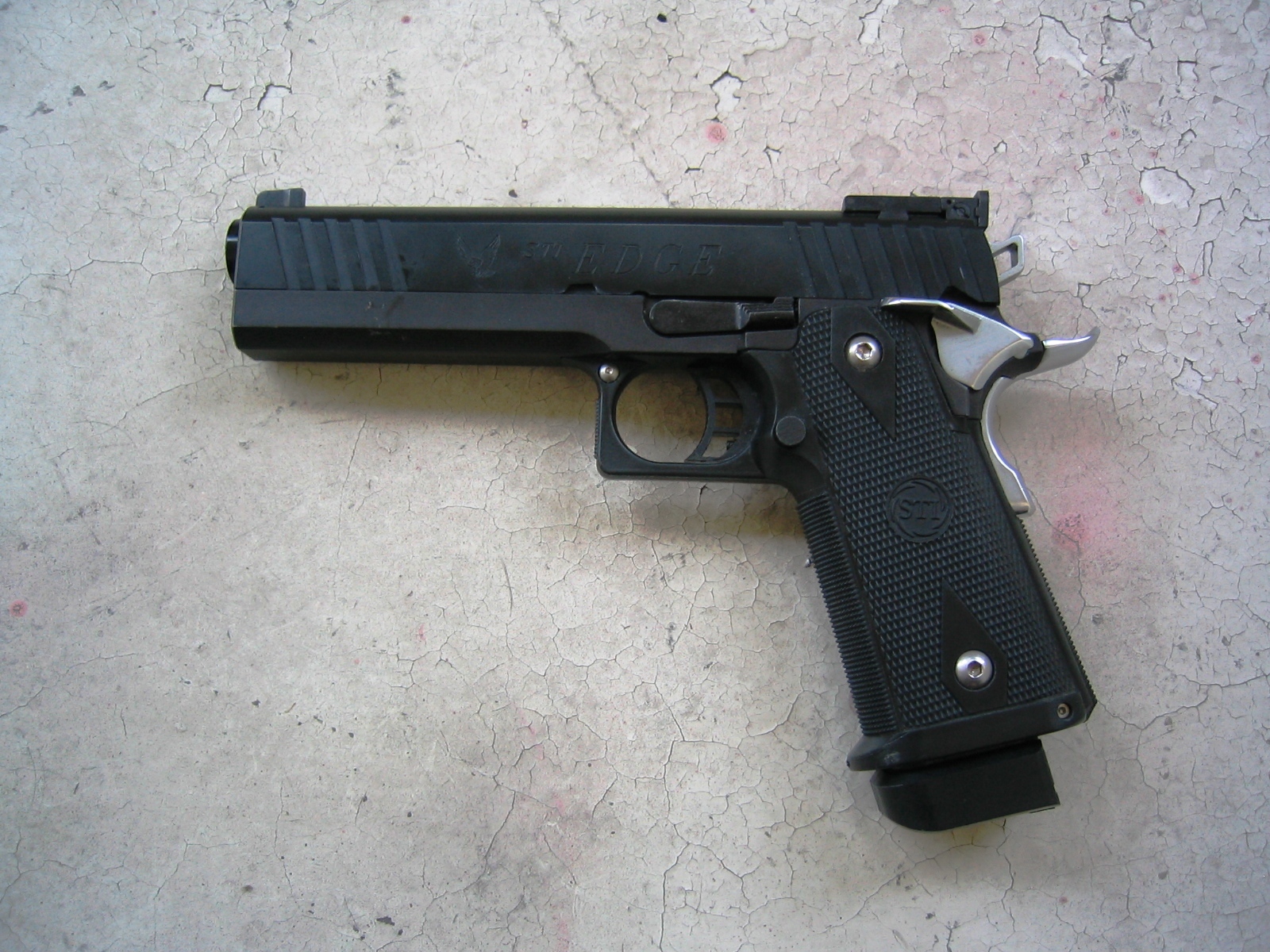
I experienced a KaBOOM event with my STI Edge (10mm) on Saturday at the ARPC range.


The Event:
The gun did literally go BOOM instead of Bang, and there was a lot of gunsmoke venting from the breach area.  The following round in the magazine did not chamber (although the bullet was pushed deeply  into the case and there was a gouge in the nose of the bullet), and in all the excitement I can't tell you now whether the slide had cycled enough to cock the hammer.  The slide lock had been pushed about 1/8" out of position, though, and the 'catch' was no longer under the slide skirt; the movement was presumably caused by the "pressure spike", so it's reasonable to presume that the slide had cycled at least far enough to allow the slide lock to move out of place (from under the slide) without damage..

And I'm certain there was a pressure spike, although I have no idea why that could have happened.  See below.

This occurred while I was demonstrating a teaching-stage at my INTRODUCTION TO USPSA class at ARPC.   Because I didn't have a volunteer "Demonstrator" at this particular class, I had resorted to my alternate practice of having members of the class act as Range Officer while I ran the demonstration stages.

The student RO didn't know what to do, so I just talked him through everything I was doing, and advised him to watch me closely to insure that I was always handling the 'malfunction' in a safe manner.  Essentially ... so that the gun was always pointed downrange; I didn't sweep myself while I was trying to clear the "Malf";   to insure that everybody else at the bay was keep safely uprange and out of the way;  and so that I had a witness to the events in case something went wrong.


The Gun:

At the time I couldn't drop the magazine,  and the slide was slightly out of battery.  I could NOT rack the slide, although it moved back in full-battery easily enough, when I pushed it..  There's now, and there was then, only about 1/8" play in the slide.  I did get the slide lock back in place, and I dropped the baseplate of the magazine to make sure the gun was definitely "unloaded" before I bagged it and left the bay.  Yes, I could thumb cock it, and dropped the hammer twice, so I was sure that there was no live round in the chamber;   later, I also dropped a squib rod down the barrel and it looks like it went all the way to the base plate, but the empty brass MAY be  still in the chamber;  I checked it again tonight, and I'm still not sure.   But I doubt it.


Lots of smoke, and lots of dirty gun-oil on my hands, but no injuries at all (just seemed like a lot more recoil than I'm accustomed to ... but that may be caused by my shock.)  Definitely, there was no "shrapnel" .. no "Thirty-Eight Super-Face".  I got one small drop of black oil on my nose, that's all.  I noticed that I kept asking everyone else if I had anything on my face ... I only expected more black oil specks, because I felt perfectly okay ... if a little shook up.

Later, I had no problems removing the magazine shell from the gun; I can't say why I was unable to do that on Saturday, but perhaps I banged the gun around enough while moving it around to loosen whatever condition had jammed it in place before.  I hadn't tried after I dumped the rounds, the spring and the follower from the magazine, so that might have been enough to relieve the tension on the magazine release.


Reloading Habits:
I have discarded the ammunition in the magazine; and am saving the rest of the ammunition from that batch; I don't intend to use it again, just to stay safe.   But I still have the damaged 'following round' from the magazine.


I really don't think it was a squib; I would have heard that.   At the time, I was shooting at a US Popper at 20+ yards, and each shot was a carefully aimed shot.  I wasn't feeling as if I was under pressure of time ... I was trying to get a good sight picture/sight alignment;  I was going to make up the first-shot miss.  And I don't think it was a double-charge, 'cause the loading press I'm using right now (an aging "Classic Lee Turret Press") doesn't have a powder measure I trust, so I'm using a "Bonanza" powder measure to include charging the rounds as a separate step of the process; I examine every round in the board after measuring powder in them, to insure that the powder level looks the same ... not underloaded, not overloaded... under a strong light as every other round; the case is about half-full  (4.5 grains of VV320 behind a 200-gr Montana Gold Truncated-round bullet -   I've been using that same load for the past 10,000 rounds plus!).

The Ammunition:
On the other hand,  I've sometimes been using moly-coated 200gr hardlead truncated lead bullets for the past 300+ rounds.  I haven't noticed any degradation in accuracy as a consequence, so it's hard to believe that I've got a barrel so leaded that it wouldn't pass a jacketed bullet.  I've written an email to "my gunsmith"  (Rob Shepherd of Shepherd Arms, to whom I intend to take the gun for examination and needed repairs) to keep an eye out for leaded lands, while he's looking at the barrel.

Frankly, I'm almost as interested in figuring out WHY, and HOW, as I am in getting the gun running again.

But the really scary thing is ... the next round out of the magazine was grossly distorted.

(1) The bullet was mashed in and discolored (by the vented gases?).


(2) The bullet was punched deeply into the case ... it looks like it was stopped by the powder in the case ... which it obviously compressed, because ..... 

(3) ... the pressure in that unfired case was so high that it forced the primer part-way out of the primer pocket! 


Remember, this round (the one on the right in these pictures) was still in the magazine after the Ka-BOOM.


Preliminary Conclusions:
I wish to emphasize, however, that although the ammunition blew up .. the gun held together!  Pending further evidence after a thorough examination of the gun, I would like to present these three preliminary conclusions:

(1)  The gun didn't vent shrapnel into the air, into the person of either the shooter (me) or the RO .. a student.  This is in direct contrast to the earlier experiences with "thirty-eight Shrapnel Face", "Glock Kaboom", and "Forty Short and Wicked" experiences.
(2) the reasons for this are that the gun and the case (10mm) are more robust than those which typified those comparative examples.  The gun was BUILT on the very sturdy frame designed and manufactured by STI.  The design of the gun included a fully supported barrel, and that "plastic hand-grip" had no problem containing the exhaust gasses.  Also, the 10mm cartridge case is MUCH more robust than the notoriously weak .40S&W; the case features much more support around the base web, which prevents the base of the cartridge case from either splitting or separating under extreme pressures .. the root cause (if you will forgive the pun) of much damage to shooters in other situations.
(3)  While I'm disappointed and distressed by the incident, I'm still a little smug.  When I bought the EDGE, I had previously talked to the President and CEO of STI (Dave Skinner) and told him that I was prepared to buy and EDGE when it was USPSA-Limited Division legal in the 10mm ... I would not buy it in its current .40S&W configuration.  Dave responded some months later to inform me that it was now legal in that 10mm configuration, and I was sufficiently confident in his word to buy the gun.  I think this experience proves that the 10mm, although the brass is nearly prohibitively expensive (at 17.3 Cents per round) is sufficiently SAFER than the .40S&W round to justify the pennys-per-round COST as opposed to the cost of paying physically for any errors I may have made in my reloading habits.

Sunday, November 27, 2011

Forty Short & Wimpy: Still kaBOOMing, after all these years

My Friend Gary the T-Man has started out sending (with permission) quotes from a highly respected firearms training facility.

This is one of the latest (November 23, 2011) "quips":

Subject: [Dtiquips] No Free Lunch!

23 Nov 11

No free lunch! This from a Range Officer with a big department:

"We ruined one of our department's G35 pistols (40S&W) last week.

During a range exercise, one of our Deputies experienced catastrophic
splitting of the pistol's frame, along with ballistic ejection of the
magazine. No significant injury, but the pistol itself is toast!

We found the offending case. It was split its entire length.

We started reloading our own training ammunition a year ago, due to the exponentially-increasing cost of new ammunition. Since, we're had a few incidents, this being the worst.

It seems, with high-pressure cartridges like the 40S&W, expansion during the firing process weakens brass cases far more than is the case with lower-pressure cartridges, and the phenomenon is not confined to Glocks. I suspect this is one reason Glock recommends against using reloaded ammunition, for any purpose!

In any event, we've reluctantly concluded that using 40S&W reloads, even for practice, represents false economy."

Comment: My friend is right! I, along with Glock, strongly recommend
against reloading 40S&W, 357SIG, and 45GAP cases, even once. Ruined guns, and personal injury, will quickly negate any savings in ammunition cost.

/John
_______________________________________________
Dtiquips mailing list
Dtiquips@clouds.com
Copyright 2011 by DTI, Inc. All rights reserved.


I've been bad-mouthing both the .40 Short and Wimpy cartridge, and Glock pistols, for years. (Search this website for the keyword "Kaboom".) Perhaps I have been overly critical.

On the other hand, in the past 10 years most of the "KaBOOM!" events I have witnessed, either directly or immediately thereafter, have involved either a Glock or a .40 S&W cartridge .. usually both, in combination.

A couple of years ago I conceded that this destructive malfunctions, perhaps caused by this combination, have greatly diminished; most probably because Glock incorporated better barrels (Fully supported) in their .40S&W chambered barrels.

Apparently, this has not yet been entirely successful in totally eliminating the "KaBoom!" factor.

History:


Two of the primary reasons for the alarming amount of explosions of .40S&W ammunition have been (a) competitors reloading ammunition with very fast-burning powder, which reaches a peak pressure exceeding the ammunition design, and (b) using competition-loaded ammunition in pistols without fully supported chambers.

Relatively recent design/production changes, which incorporated fully-supported chambers in GLOCK barrels, supposedly "eliminated" these problems. It now appears that it has reduced, but not entirely eliminated, that problem.

This "KaBoom!" factor is the primary reason why, when I ordered an STI Edge in 2000, I specified 10mm caliber rather than .40 S&W. The Mighty Ten has a much stronger case than the .40 S&W, especially in the region near the base ... where most "KaBOOM!" events occur because the unsupported case AND the relatively weak case design usually result in explosive detonation.

In ten years of competition, I have never experienced a "KaBOOM!" detonation using a 10mm pistol/case, with a fully supported chamber, after thousands of rounds of major-power ammunition with USED ammunition, loading Vihti Vourhi N320 powder behind 200gr Montana Gold bullets.

Glock and Reloaded Ammunition:
Glock has, as the article specifies, ALWAYS warned owners against the use of 'reloaded" ammunition. This article demonstrates why that is a prudent precaution.

Unfortunately, when one is competing with ammunition which can cost approximately $16 per box of 50 (and up!), and expecting to use 'about' 150 rounds of ammunition in a match ... the $45+ cost of ammunition (plus the match fees, travel, etc.) places the cost of competition outside the range of fiscal ability for most of us, except for perhaps one match per month.

Most pistol ammunition is reloadable for $7 to $10 per box of 50 (assuming reasonable retrieval of expended brass), which is sufficient to allow TWO club matches a month, for the same or less price of using factory ammunition. (Probably less for 9mm.)

But Glock says "Do not use reloaded ammunition" for ALL of its products, even the Glock 17.

I agree, the cost of using factory ammunition is FAR less than the cost of replacing a pistol .. or worse, the pain and expense of hospital bills in the worst cases.


Still .... why shouldn't I accept both safety AND economy, if it's available in a different pistol/caliber combination?

Thursday, June 10, 2010

The First "Fish Flop"

Given the great kerfuffle about yesterday's post describing WhiteFish's demonstration on "how to take a fall and come up shooting", it seemed necessary that I provide some visual documentation.

June of 2006, Tri County Gun Club, Stage 1.

Starting prone on a platform, grab your pistol from one of the barrel and engage all targets as they become visible.

Unfortunately, the barrels were staked down using 9" spikes. The ground was so hard, they weren't pounded in very deeply. it was difficult to avoid them when moving from one side of the stage to the next.

The inevitable happened
... to WhiteFish!

Fortunately he recovered quickly and with a minimum of damage.

The video wasn't filmed from the best angle, but it's obvious that he managed to keep the muzzle pointed in a safe direction while rolling around in the dirt, and although he had to quickly clear a jam he kept his head and finished the stage as aggressively as he had begun it.


The man has the reflexes of a cat!

(NOTE: The title on the video is in error. The match was in 2006, not 2009.)

Sunday, June 28, 2009

Glock KaBOOM!


I don't want to give the impression that Glock pistols are intrinsically unsafe, or that the reason why they occasionally blow up [KaBOOM!] has anything to do with the design.

Still, I so wish to provide you with as much information when they Glocks DO blow up.

Here's an example of what the Glock Barrel looks like when it blows up.
(Actually, I expect to show several aspects of a "Blown-Up Glock".)


Here is one example of a Glock Barrel after a "Ka-BOOM!" moment.

The accompanying photos don't shot the entire mechanical disintegration, but they are very clear about the consequences.

The owner of the Glock (Fish) was careful to stipulate that three gunsmiths, including a Glock Armorer. found no evidence of a Squib.

Similarly, they found no evidence that the round was "Double-Charged".

So why did the Glock blow up?

Damned if I know.

Fish notes that not only was the barrell effectively distroyed, but so was the trigger group. (He sent this off to a Name Brand Glock gunsmith, and two other Gunsmiths, and the consensus was that the Trigger Group could not be repaired.)

Sunday, January 11, 2009

Fish Splash

I went to a USPSA match in Albany this weekend. It was a classifier match, and although I wasn't competing I did show up to see some folks and maybe take some pictures.
The match was almost over when I dragged out the camera to take a video of Fish shooting the last of the two Field Course" Stages, which included a Texas Star, a half-dozen IPSC targets, and a couple of 9" steel plates.

I thought it was a good run, but only mildly exciting (except for the shooter, of course).

When Fish came off the stage, after having bagged his pistol, he held up his hands and announced to The Peanut Gallery:

"Hey, I'm bleeding!"

Sure enough, he was leaking, and from both hands.

As we took a short break to try to staunch his wounds, Fish told us the story.

He started out at stage left engaging four paper targets, then moved to the right to pick up the two steel and two more paper. He said he took the steel first, and that was when one of the bullets (more likely a large, jagged bullet fragment, judging from the way his fingers were sliced & diced) bounced directly and struck him where his fingers were overlapped at the front of the grip.

He said it hurt, but he went ahead and engaged the two paper targets on the right, then moved back a step to engage the Texas Star through the port.

Here's how it looked from the Peanut Gallery:


___________________________

Can you tell when the ricochet struck? I can't. Here's a picture or two from the early attempts to 'stop the leaking'. (Note: if you can't stand the sight of blood, this may not be something you want to look at. But it's not gory, or NSFW.)

Picture 1: Trying to apply bandaids. (Yes, they are trying to use target tape to wrap the fingers.)


Picture #2, after the first couple of bandaids were applied:


Here's the story from Fish, from an email he sent 'later':


Trip to urgent care at Kaiser where they gave me a tetanus shot, took a look, and packed me off to the ER at Salem Hospital because of the chance of tendon and nerve damage. I didn't get back here until 8. Several X-rays showed nothing broken and no metal debris in the wounds, but I did have two deep puncture wounds on the middle finger of my left hand, a puncture wound to the middle finger of my right hand, and a nasty cut on the inside of the index finger on my right hand that finally required three stitches to close. Thank you to everyone who helped me, including the unknown good Samaritan at the range with a first aid kit who bandaged me up.

The ER doctor told me the new scars are\will be the sign of a life well lived.


Well, it's not the first time we've seen blood on the range, but it is a good example of the concern for safety involved in IPSC/USPSA competition.

After 25 years of competition, I have yet to see an injury which involved more than a few stitches, at worst. I've seen some serious Road Rash in the summer, from people in shorts who fall down while running on the gravel. In fact, I've had a couple of them myself.

And I've known ricochetting bullets to bounce back among the spectators, causing minor scratches or a small bruise at worst.

Compared with, for example, High School Football or High School Basketball, this Practical Shooting thing must be one of the safest competitive activity one can hope to find.

To compare, here are some of the web-based links to injuries in other competitive sports:
I've focused here, where possible, on injuries incurred by minors .. Middle School and High School. I haven't even touched on the 'individual sports' such as Wrestling and Boxing. But we will know that it's a rare year which completes without some death or permanent injury being incurred by one of these sports, which are more acceptable than the Shooting Sports (in the opinion of most people.)

In my personal opinion, a sport which most commonly leads to permanent joint injury, or permanent head trauma (eg: boxing) is more dangerous than any of the shooting sports.

It is perhaps indicative that I have made so much of a series of minor slices to the fingers, not even involving broken bones or damaged tendons.

BTW, I labeled this a "KaBoom" moment for purposes of comparison. This was not a "KaBoom"; the firearm functioned perfectly, and the latest word is that there was no damage to the pistol. This would probably not be true if a full-diameter bullet had bounced back with anything near to the initial velocity of the bullet. (If Mr. Fish informs me that the pistol was damaged, I will of course correct this impression.)

Tuesday, August 19, 2008

Finger! Finger!

And I ask, whose paranoid are you?: Feral Shoots Self, Other Feral, Drops Pistol.

A U.S. Marshal managed to shoot himself in the butt, and another officer in the ankle, while holstering his pistol after dropping off a prisoner early this month.

As David Codrea said, it's a "Two-Fer".

The full video is available here, while an edited, but larger-format segment of the video is available from KVIA-TV here.
____________________________________

The rest of this is pure speculation on my part.

It appears that, while holstering his pistol, the Marshal allowed some portion of his anatomy (his finger?) or his apparel (the tail of his snazzy photographer's vest?) to come between the holster and the trigger. When he jammed the pistol into the holster, that darned thing "Just ... went off!" (Imagine that? Darned guns, they do that a lot. "Not my fault!")

I'm obviously playing in my mind the scene where the U.S. Marshal attempts to justify the 'incident' to his superiors.

The thing is, this is exactly the kind of incident that is addressed (and almost universally avoided) by training competitors in the many "Practical" shooting venues: IPSC, USPSA, IDPA -- they all emphasize that you absolutely must keep your booger-hook off the bang-switch while holstering.

I know, I know. This guy must deliver prisoners on a daily basis, and he must always be required to deposit his pistol in the lock-down area. He probably re-holsters his pistol several times a day, five days a week.

Still, he screwed up.

What will you bet that the U.S. Marshal's Service institutes, within the next 30 days, a program of remedial training in "Safe Holstering" for all agents?

They could save themselves a lot of training time and expense if they just required their agents to enroll in a Practical Shooting sport, and attend at least one match each month.

Jeff Cooper's Rules of Gun Safety

RULE I: ALL GUNS ARE ALWAYS LOADED

RULE II: NEVER LET THE MUZZLE COVER ANYTHING YOU ARE NOT WILLING TO DESTROY

RULE III: KEEP YOUR FINGER OFF THE TRIGGER UNTIL YOUR SIGHTS ARE ON THE TARGET

RULE IV: BE SURE OF YOUR TARGET


Question: How many of these rules are violated here?
Answer: at least three; perhaps all four.

Darned FBI-slant holsters, anyway.

Monday, May 26, 2008

Glock KaBOOM! - Follow-up

Email from Evil Bill about the unfortunate demise of his "Pelican Gun":

Pictures of the kaboom. [attached to the email]

Jerry, you said you thought you saw something fall out of the gun? It was half of the locking lug. Or at least that is what's missing!

The "earth shattering kaboom"( I like Marvin the Martian quotes) didn't even flatten the primer much. Case has no cracks, not even a blown primer. It would sure be interesting to see a slo-mo of the kaboom---I still haven't figured out how the barrel jumped forward to allow the locking lug to go up, over and behind the locking block.

As near as I can tell damages are: Barrel, slide, locking block, locking block pin. Also think it sheared a screw on the Docter sight diode mount, but I think I have a spare.

Frame, comp, trigger components, mag release, recoil spring/guide rod, all the internal slide pieces look OK. Heck---I might beat the slide back into shape and use it on a steel gun. It's only bulged an eight inch or so, and the cracks aren't too bad.

Bill
In a later email:
Jerry, Got out the magnifying glass and a good light and checked the bore on the split barrel. I can see a ring in the barrel just past the second blow hole from bullet #1. Also a chunk of bullet jacket lodged in the crack just toward the chamber from the ring. Guessing that the jacket is from bullet #2. Neither bullet stayed in the bore. Evidently one of them impacted the target I was aiming at when the kaboom occurred?
That would explain the number of holes in targets.


The most important thing is that Evil Bill was not injured by this mishap. The only physical effect he found was a small black spot on his trigger finger; I can only guess that it was caused by exhaust gases (read: powder residue) blasted downward through the trigger port of the frame.

It bears repeating that, so far, there is no evidence that the KaBOOM! was caused by a structural weakness of the ammunition, the cartridge/caliber, or of the pistol.

We searched the ground in front of the shooting position to see if we could find evidence of a squib. We were looking for a bullet or bullet fragments. There were some jacket fragments within a few feet of 'ground zero', but we couldn't determine that they were even of recent origin, let alone related to this incident.

I remain unconvinced of the 'squib' theory, but I can offer no more likely explanation.

I have loaded the pictures to Jerry the Geek's Online Shooting Gallery, you can view them here.

Other KaBOOM! Links:

The Original KaBOOM! from August, 2006.

Dean Speir on the KaBOOM! Phenomenon, The Gun Zone, Glock kB! FAQ v1.35

It's only fair to point out that, even though Evil Bill zeroed the last of six stages in this match (match results here), he ended up 11th overall out of 64 shooters, and first B-Open.

In case you are persuaded by the earlier reporting, here is what Evil Bill's Penguin Gun typically looks like when shooting a stage:

Sunday, May 25, 2008

Glock KaBOOM! - Major Nine

At the Dundee Club Match (May 24, 2008) and on the very last stage of the match, Evil Bill Blew Up His Pelican Gun.

Bill was shooting the last stage of the day, and I was his RO. About 5 shots into the COF the gun failed to go back into battery.


Bill racked the slide to chamber the next round, pulled the trigger, and as I was watching the gun split into two pieces, attached to the grip, in a configuration reminiscent of a half-peeled banana.

Bill's later theory was that he had a squib, which was not obvious to the observer because the bullet got into the compensator before it was stopped. (He had been recently made aware that his powder measure was randomly loading lighter than normal charges; as much as almost 20% lighter than normal.) In fact, in this scenario it would not be a 'squib', per se, as much as a 'light load'.


Nevertheless, he suggests that the round which split the barrel and pulled the slide away from the frame did in fact result in excessive pressure which split the barrel from just behind the compensator to the chamber of the pistol.

I don't know that I accept that explanation. I counted the rounds, I think that the round he designated a 'squib' actually hit the A-zone of the target he was engaging. I could be wrong, he could be wrong, we both could be wrong.

I'll be interested if, when he disassembles the Glock, he can provide more information to describe the actual sequence of events.


Oh, yeah, I forgot one detail of the damage. It appears that the slide has also bulged, just forward of the chamber. Well, that's not surprising.

(Click on any picture to Super-Size it)

Sunday, April 20, 2008

Forty KaBOOM!

A couple of months ago at the Dundee match, a friend picked up a piece of brass and brought it over to show me.

"Somebody had a lot of trouble on this stage", he said. "Looks like his ammo blew up, and it locked up his gun for a while. I'm thinking ... double-charge of powder."

I was only mildly curious at the start, but once I looked at the cartridge case I had to agree.


In the first place, the case was dramatically bulged on one side, which suggests not only an overcharge but also that the case was fired in a barrel without a fully supported chamber.


When I looked at the base, I saw more signs of abuse. The headstamp was almost completely obliterated, which suggests that this case had been fired so many times that the headstamp was eroded to the point of being erased. That's not a problem with the base, which is the strongest and thickest part of the cartridge case, but it does suggest that excessive reloading may have caused the sidewall of the case to have been weakened.

On the other hand, is it possible that the headstamp may have been partially obliterated because the pressure of the overcharge (?) pressed the base of the cartridge against the breech so fiercely that the headstamp was malformed?

Looking at the case more closely, the case didn't split; it wasn't an 'explosive' KaBoom, only the kind of situation where the case can be jammed in the chamber and cause the shooter a delay in completing a stage while he strives to extract a bulged cartridge.

As evidence of the problem, take another look at the cartridge base. The missing primer is an almost certain indicator that the cartridge was overcharged. The only other condition which would cause the primer to be ejected from the cartridge case is if the case had been fired so many times, the primer pocket had eroded or expanded ... allowing the primer to be ejected when the cartridge was fired under 'normal' pressures.

In this situation, if the primer was only loosely held in the primer pocket, the pressure would probably not have been contained to the point that the case wall was bulged. (This isn't an infallible test, it depends on the timing of the pistol; if the wrong size link is used in a 1911, the release of the slide to recoil may have been delayed to the point at which the pressure built up too much on almost every shot. But this would suggest a number of KaBooms.)


The final information to be gathered by examination of the case is that the base shows not one, but two places where the rim of the cartridge has been obviously deformed by slippage of the extractor, which probably left the cartridge case jammed in the chamber.

We would have expected one such sign of extractor failure, but two of them suggest that this is the second time this case has failed.

I don't believe that; I don't think that a blown case was reloaded, and I don't believe that extractor slippage happened twice on exactly opposite sides of the base on the same cartridge.

But I would appreciate the contribution from a more knowledgeable reader to explain the diametrically opposite marks on the cartridge base.

Or is there a Forty Slow and Wimpy pistol on the market with dual extractors?

---

We've made a lot of assumptions based on a minimal amount of real data. Anyone who can claim more technical expertise is invited to contribute here.

Enquiring people want to know. Please respond in Comments.