Showing posts sorted by relevance for query kaboom. Sort by date Show all posts

Monday, May 26, 2008

Glock KaBOOM! - Follow-up

Email from Evil Bill about the unfortunate demise of his "Pelican Gun":

Pictures of the kaboom. [attached to the email]

Jerry, you said you thought you saw something fall out of the gun? It was half of the locking lug. Or at least that is what's missing!

The "earth shattering kaboom"( I like Marvin the Martian quotes) didn't even flatten the primer much. Case has no cracks, not even a blown primer. It would sure be interesting to see a slo-mo of the kaboom---I still haven't figured out how the barrel jumped forward to allow the locking lug to go up, over and behind the locking block.

As near as I can tell damages are: Barrel, slide, locking block, locking block pin. Also think it sheared a screw on the Docter sight diode mount, but I think I have a spare.

Frame, comp, trigger components, mag release, recoil spring/guide rod, all the internal slide pieces look OK. Heck---I might beat the slide back into shape and use it on a steel gun. It's only bulged an eight inch or so, and the cracks aren't too bad.

Bill
In a later email:
Jerry, Got out the magnifying glass and a good light and checked the bore on the split barrel. I can see a ring in the barrel just past the second blow hole from bullet #1. Also a chunk of bullet jacket lodged in the crack just toward the chamber from the ring. Guessing that the jacket is from bullet #2. Neither bullet stayed in the bore. Evidently one of them impacted the target I was aiming at when the kaboom occurred?
That would explain the number of holes in targets.


The most important thing is that Evil Bill was not injured by this mishap. The only physical effect he found was a small black spot on his trigger finger; I can only guess that it was caused by exhaust gases (read: powder residue) blasted downward through the trigger port of the frame.

It bears repeating that, so far, there is no evidence that the KaBOOM! was caused by a structural weakness of the ammunition, the cartridge/caliber, or of the pistol.

We searched the ground in front of the shooting position to see if we could find evidence of a squib. We were looking for a bullet or bullet fragments. There were some jacket fragments within a few feet of 'ground zero', but we couldn't determine that they were even of recent origin, let alone related to this incident.

I remain unconvinced of the 'squib' theory, but I can offer no more likely explanation.

I have loaded the pictures to Jerry the Geek's Online Shooting Gallery, you can view them here.

Other KaBOOM! Links:

The Original KaBOOM! from August, 2006.

Dean Speir on the KaBOOM! Phenomenon, The Gun Zone, Glock kB! FAQ v1.35

It's only fair to point out that, even though Evil Bill zeroed the last of six stages in this match (match results here), he ended up 11th overall out of 64 shooters, and first B-Open.

In case you are persuaded by the earlier reporting, here is what Evil Bill's Penguin Gun typically looks like when shooting a stage:

Sunday, November 27, 2011

Forty Short & Wimpy: Still kaBOOMing, after all these years

My Friend Gary the T-Man has started out sending (with permission) quotes from a highly respected firearms training facility.

This is one of the latest (November 23, 2011) "quips":

Subject: [Dtiquips] No Free Lunch!

23 Nov 11

No free lunch! This from a Range Officer with a big department:

"We ruined one of our department's G35 pistols (40S&W) last week.

During a range exercise, one of our Deputies experienced catastrophic
splitting of the pistol's frame, along with ballistic ejection of the
magazine. No significant injury, but the pistol itself is toast!

We found the offending case. It was split its entire length.

We started reloading our own training ammunition a year ago, due to the exponentially-increasing cost of new ammunition. Since, we're had a few incidents, this being the worst.

It seems, with high-pressure cartridges like the 40S&W, expansion during the firing process weakens brass cases far more than is the case with lower-pressure cartridges, and the phenomenon is not confined to Glocks. I suspect this is one reason Glock recommends against using reloaded ammunition, for any purpose!

In any event, we've reluctantly concluded that using 40S&W reloads, even for practice, represents false economy."

Comment: My friend is right! I, along with Glock, strongly recommend
against reloading 40S&W, 357SIG, and 45GAP cases, even once. Ruined guns, and personal injury, will quickly negate any savings in ammunition cost.

/John
_______________________________________________
Dtiquips mailing list
Dtiquips@clouds.com
Copyright 2011 by DTI, Inc. All rights reserved.


I've been bad-mouthing both the .40 Short and Wimpy cartridge, and Glock pistols, for years. (Search this website for the keyword "Kaboom".) Perhaps I have been overly critical.

On the other hand, in the past 10 years most of the "KaBOOM!" events I have witnessed, either directly or immediately thereafter, have involved either a Glock or a .40 S&W cartridge .. usually both, in combination.

A couple of years ago I conceded that this destructive malfunctions, perhaps caused by this combination, have greatly diminished; most probably because Glock incorporated better barrels (Fully supported) in their .40S&W chambered barrels.

Apparently, this has not yet been entirely successful in totally eliminating the "KaBoom!" factor.

History:


Two of the primary reasons for the alarming amount of explosions of .40S&W ammunition have been (a) competitors reloading ammunition with very fast-burning powder, which reaches a peak pressure exceeding the ammunition design, and (b) using competition-loaded ammunition in pistols without fully supported chambers.

Relatively recent design/production changes, which incorporated fully-supported chambers in GLOCK barrels, supposedly "eliminated" these problems. It now appears that it has reduced, but not entirely eliminated, that problem.

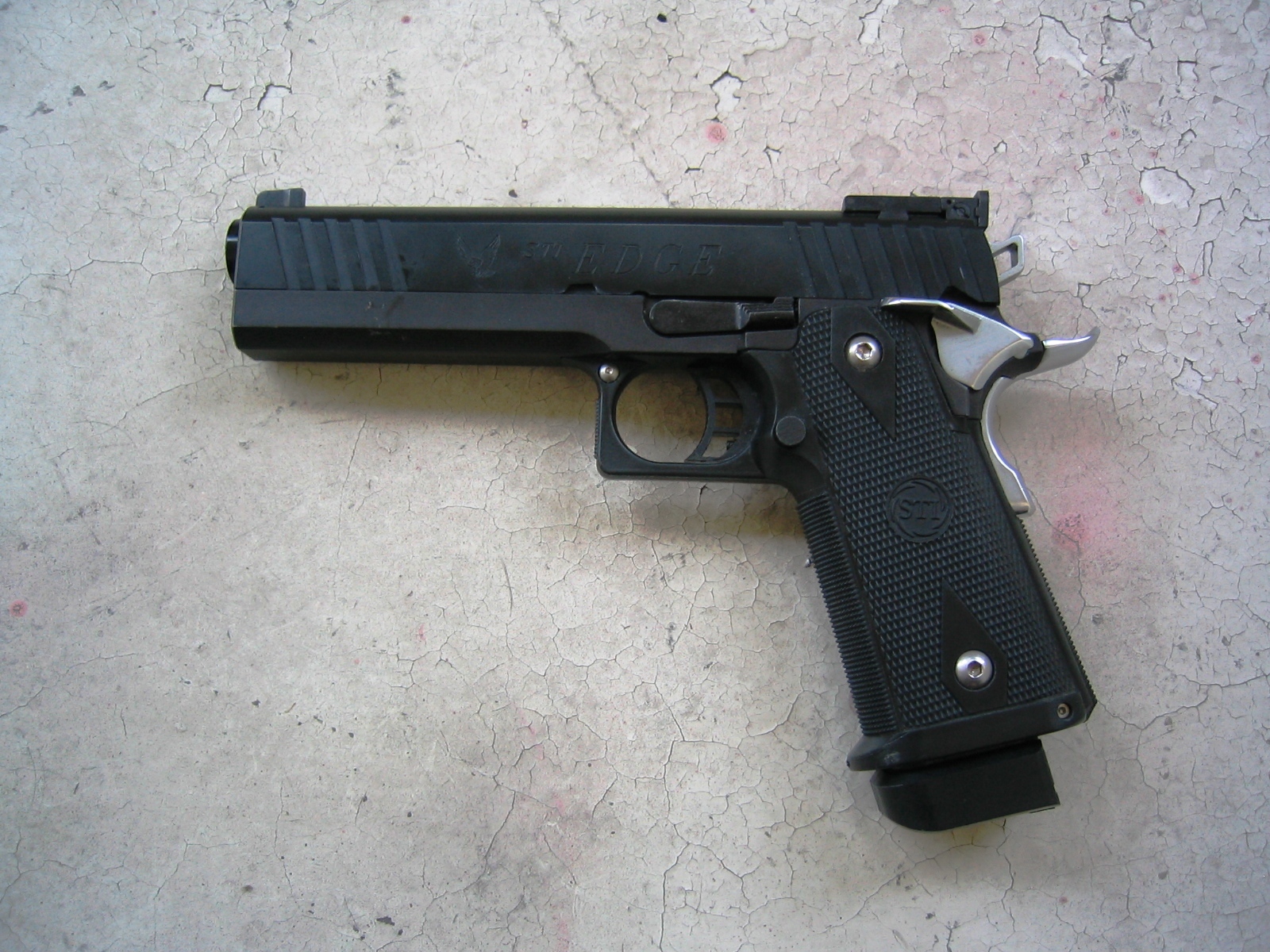
This "KaBoom!" factor is the primary reason why, when I ordered an STI Edge in 2000, I specified 10mm caliber rather than .40 S&W. The Mighty Ten has a much stronger case than the .40 S&W, especially in the region near the base ... where most "KaBOOM!" events occur because the unsupported case AND the relatively weak case design usually result in explosive detonation.

In ten years of competition, I have never experienced a "KaBOOM!" detonation using a 10mm pistol/case, with a fully supported chamber, after thousands of rounds of major-power ammunition with USED ammunition, loading Vihti Vourhi N320 powder behind 200gr Montana Gold bullets.

Glock and Reloaded Ammunition:
Glock has, as the article specifies, ALWAYS warned owners against the use of 'reloaded" ammunition. This article demonstrates why that is a prudent precaution.

Unfortunately, when one is competing with ammunition which can cost approximately $16 per box of 50 (and up!), and expecting to use 'about' 150 rounds of ammunition in a match ... the $45+ cost of ammunition (plus the match fees, travel, etc.) places the cost of competition outside the range of fiscal ability for most of us, except for perhaps one match per month.

Most pistol ammunition is reloadable for $7 to $10 per box of 50 (assuming reasonable retrieval of expended brass), which is sufficient to allow TWO club matches a month, for the same or less price of using factory ammunition. (Probably less for 9mm.)

But Glock says "Do not use reloaded ammunition" for ALL of its products, even the Glock 17.

I agree, the cost of using factory ammunition is FAR less than the cost of replacing a pistol .. or worse, the pain and expense of hospital bills in the worst cases.


Still .... why shouldn't I accept both safety AND economy, if it's available in a different pistol/caliber combination?

Saturday, October 06, 2007

TGZ - Boom and Bust


No, this isn't The Gun Zone, this is.

I'm a long time of The Gun Zone, which is the love-child of self-professed 'formerly famous gun writer' Dean Speir. (I got the spelling right first try that time, Dean!)

KaBOOM!
Last year I stole shamelessly from Dean's website for my infamous 'KaBOOM!' article, which remains one of the half-dozen consistently highest ranking articles on Cogito Ergo Geek (based on frequency of access ... usually by Internet Search.)

(For this and all vaguely related articles, type kaboom in the 'search' window at the top of this page.)

It's unfortunate that, due to Dean's documentation of the Glock KaBOOM! Phenomenon, Dean has been fighting an undeserved reputation as being 'anti-Glock'.

Dean is NOT 'anti-Glock', but I am. It's all the fault of the kool-aid kids anyway, so I admit I don't care.

The eminent and inimitable Mr. Speor Spier Speirs Speir, in an admirable effort to contest this cruel canard, has consequently included a cornucopia of case studies of OTHER (defined as 'non-Glock') KaBOOMs, squibs, and miscellaneous firearm failures.

A case in point is the HK USP Expert kB!, which describes the (2002) destructive malfunction to a .45 caliber HK. Since this article is sub-titled "Why not to shoot lead handloads through a barrel with polygonal rifling", it implies that there is just one more thing to remember when you move away from the perfect John Browning 1911 pistol design.

(Notice how perfectly my articles mirror my personal bias? I'm sure it's mere coincidence.)

While I'm tempted to link to ALL of the 'KaBOOM!" articles on TGZ webpages, I'll not allow myself to be guilty of distracting you from a superior website.

And that's why I won't embed TGZ's YouTube video which most caught my attention today.

You're Busted!


In the Miami Vice television series which was popular in the 1980's, one episode ("The Hitman") was noticed by competitive Practical Pistol shooters. Competitive shooter Jim Zubiena portrayed a 'hit man' who blew away a limousine load of drug dealers with a SPAS-12 shotgun, and then performed a "flawless Mozambique" (with a 1911) on the armed and alert bodyguard ... from surrender position, with a concealed carry.

To tell the truth, I can only see two shots, not three, in the embedded YouTube video. You may have better eyes than I do, but it all happens so fast it's difficult to be sure.

Go read the article, and the related links, and see the video here.

You may be interested to know that, based on Dean's commentary, I just ordered Seasons One and Two of Miama Vice here.

It's not just the Pastel-o-vision, or the music.

well, in part it's the music, but I already bought that cd last year.

Thursday, August 17, 2006

KaBOOM!

I've been shooting IPSC for a long time. While I'm just barely good enough not to quit, I have long ago learned that what I see and what I learn are often more interesting than what I do.

One of the things I have learned is that ISPC competition usually involves a LOT of shooting with many different kinds of pistols. Not all of them were originally designed for this kind of continuous shooting.

One of them is the Glock.

Another is the .38 Super, as produced by just about anybody.

I know what you're thinking. You've read the title of the article, you got this far, and your knee-jerk reaction is probably one of the following:

  1. Yeah, but Glock fixed that!
  2. Yeah, but STI (SV, name your own favorite manufacturer of .38 super pistols) fixed that!
  3. It wasn't the gun, it was reloading brass which had been used too many times!
  4. It wasn't the gun, it was using the wrong powder!
Okay, you may be right. But These Things Still Happen, and I want to spend a little time on IPSC History so indulge me a while, okay?

(In keeping with the "These Things Still Happen" concept, I'll probably be telling you a few things you already know. There may be some folks who don't already know this stuff, and I want to use this opportunity to put a bug in their ear.)

This will be a certified Geek-Length Article, and I can do that because I'm a big mouth. You are an honored and invited guest, but everything I do is for me.

One of the things I do for me is the sidebar links. You may think I put them there to draw your attention to information resources which you may find interesting. In reality, I put them there so I have a quick-link to information resources which I find interesting. As such, I spend some time almost every day revisiting them, and often I learn from them.

One of the interesting links I have included is The Gun Zone, the love child of veteran gunzine writer Dean Speir. I've delved into TGZ from time to time, but never really surfed it thoroughly. I devoted some time to that pleasant burden recently and found the site to be rich in knowledge, experience, wisdom (not the same think as knowledge or experience ... it depends on the man), and information. Your enjoyment of the information depends in turn on whether you click on the many links provided in the text of Speir's articles.

Reading his lead article, I found a reference to what Speir calls kB!. To my delight, I found this to be a fairly rigorous and eminently informative white paper about the phenomenon which I have, in various other writings, referred to as "KaBOOM!" ... the tendencies of nervous, high-strung or over-stressed pistols to blow up during shooting.

There are a lot of reasons for guns to blow up.

One of the more esoteric reasons is that you have jammed your rifle barrel in the dirt, and thus plugged the barrel with said dirt. (We saw that in the John Wayne western movie Rio Lobo, essentially a 1970 remake of the 1966 Wayne Western El Dorado, in which Dirty Sheriff "Blue Tom" Hendriks gets shot in the leg in the Shootout Scene and uses his Winchester Rifle as a crutch until he is confronted by the vengeful Amelita. Note to Self: never use your Winchester as a crutch, especially if you've slashed the face of a fiery Hispanic Ho.)

There are many less exciting ways to get a KaBOOM! out of your competition gun, though.

Historically, the KaBOOM! phenomenon wasn't a big factor in the early days of IPSC.

Sure, it was sometimes possible to get a double-charge in your .45 acp 1911 if you were using one of the flat-leaf shotgun powders, such as Alliant Red Dot. But most of us who used this type of powder were more likely to use the slower-burning powders such as Green Dot. And sometimes folks using Hercules Bullseye (a fine-grain spherical powder) could overcharge, too.

.38 Super-Face

Free Image Hosting at www.ImageShack.usThe KaBOOM! factor was never important until some daring young man (probably Brian Enos) realized that the all-but-forgotten .38 Super cartridge could be used in a pistol which had higher magazine capacity (akin the the 9x19 nine millimeter parabellum, but with a longer cartridge case it had the capacity to legally "make major" ... if loaded with MORE POWDER and which avoided the IPSC rule relegating 9x19 cartridges as "minor power".)

At about the same time, they discovered compensators.

This was a device which could be attached to the muzzle of the barrel. It was a steel cylinder with holes cut in the top. The weight helped keep the muzzle from bouncing with recoil after each shot ("Muzzle-Flip"), but the holes in the top allowed excess gasses to exhaust and, similar to a rocket motor, exerted an "equal but opposite" force DOWNWARD to reduce the muzzle-flip even further. The result was that you could fire a Major Power round and the muzzle pretty much stayed on-target.

Major Power, fast double-taps; what more could a young IPSC competitor wish for?

Well, he could wish to retain his boyish good looks without facial scaring, because the compensator required a LOT of gunpowder to provide the excess gasses, and competitors were loading more and more very fast powder into their long .38 super cartridges for the sole purpose of jetting the exhaust through the compensator.

The result of this daring experimentation was that the .38 super cartridge, which had not originally been designed for such high pressures, was sometimes unable to contain all of those excess gasses. Something has to give, and occasionally the case split laterally along the web of the case base. The gasses vented against the breach, which in reaction opened sufficiently to vent them up and back resulting in what has colorfully been termed "Thirty Eight Super-Face".

What this is, is that the hot gasses, the burning powder fragments, and pieces of brass from the bursting cartridge case blew UP and BACK to where the competitors face was conveniently (or not, depending on your point of view) waiting.

Facial skin is not designed to endure this kind of physical assault. While I never heard of anyone being actually blinded while acquiring a .38 SuperFace, I strongly suspect this is only because of the mandatory requirement to wear protective glasses. However, full-face motorcycle helmets were never mentioned in the USPSA Rule Book, so a lot of this hot crap scrap found fertile ground for flesh-rending and burning into the underlying musculature. The result was pain, secondary infection, facial disfigurement and a few IPSC competitors who decided that they would grow a beard to hide the scars.

Super Rob and I both wear beards, but it isn't necessarily because we have Super-Face. We're just styling.

The other guys, well, they're doing what they can to look 'normal'.

Eventually, the .38 Super shooters realized that there were a couple of things they could do to avoid this unfortunate down-side to hi-cap/major-power expediency:
  1. use slower-burning powder, to avoid pressure spikes
  2. install a barrel with a fully supported chambers, to help the case retain the pressure

Handgun manufacturers, especially STI and SV, built their business on .38 Super competition guns with fully supported chambers.

The cartridge manufacturers chipped in to the obvious marketting message, and provided a case with a thicker web.

These cartridge (not ammunition) manufacturers such as Winchester, Remington/Peters and others completed the third leg of the .38 super Road to Salvation.

  • Slow-burning powder allowed the generation of high gas-pressure to make the compensators work, without generating it in the first few thousandths of a second after ignition.
  • The fully supported barrels (now standard on such competition-specific guns such as the STI Competitor) helped hold the pressure in without stressing the case unduly.
  • the stronger case design accepted more of the pressure burden, and not only prevented lateral case-splits but helped contain longitudinal splits in the case.
We were saved! No more 38 Super-Face! We can go back to developing hot loads to make major power, and we don't have to chance facial disfigurement and injury to hands because your ammunition may cause your gun to blow up!

Glock and the .40 Slow and Wimpy
Image Hosted by ImageShack.usThen Glock introduced the Glock 22 in .40 S&W cartridge, with performance riveling the .45acp and magazine capacity riveling the 9mm guns.

Unfortunately, instead of chambering the strong Glock 21 .45acp gun for the smaller .40 S&W cartridge, they chose to chamber the weak Glock 17 9mm gun for the more powerful (and higher pressure) .40 S&W cartridge.

Well, it was a marketting thingie.

The consequences: KaBoom!, The Next Generation!

What are we looking at here?
  1. Barrels without fully supported chambers.
  2. Barrels which are intentionally built 'loose', so they can accomodate cartridges with varying diameters (eg: "you can shoot anything in a Glock!")
  3. Handguns deliberately built on a 'weak' frame, instead of the readily available 'strong' frame.
Perhaps we're being too critical here.

Or perhaps not.

Glock was at a decision point. They could use a design which was stronger than the (new, relatively untested) .40 S&W cartridge ... the frame designed for the powerful .45acp cartridge .. or they could use a design which was lighter, less robust, but cheaper to make and intended for the poodle-shooter 9x19 (9mm Luger, 9mm Parabellum, etc.) cartridge.

Let me see: over-engineer for safety, or under-engineer for profit. What are the chances that somebody will over-load a .40 S&W round? What to do, what to do ...

Ultimately, Glock built the Glock 22 on essentially the same frame as the Glock 17.

MAYBE this decision was based on the lesser amount of material used in the 9mm Glock 17 as opposed to the 45acp Glock 22 21 [corrected].

MAYBE this decision was based on the fact that the cartridge diameter was closer to the 9mm (.35*") than the .45 (.45*"), so they had less machining to deal with.

My guess is that they were looking at the ejector placement.

The .40 S&W cartridge uses a small primer, as does the 9mm.

The .45acp uses a large primer.

The ejector is sited in the frame relative to the primer diameter.

Could it have been as simple as a reluctance to change the tooling on the Glock 22 to a position more appropriate to the Glock 17?

I don't know, but essentially the major difference between the Glock 17 (9mm) and the Glock 21 (.40S&W) is the barrel. No retooling for the rest of the gun is needed or desired, except for the stamped model and caliber markings.

Go look at the cited links for the Glock 17 (9mm), Glock 21 22 [corrected] (.40S&W) and the Glock 22 21 [corrected] (.45acp). What you will see, if you look at weight, is that the Glock 21 is several ounces heavier. More robust. Perhaps even more able to resist both recoil and internal pressures.

Except that the as-issued Glock 21 22 [corrected] had the same barrel design; the chamber was not fully supported.

Add to that the popularity of the new Clays powder, which was working just fine for both 9mm and .38 super ammunition, and as it was the new hot powder-de-jour there was a lot of of forty-caliber ammunition loaded with Clays.

I refer you now to one of my favorite reloading pages: The Reloading Pages of M.D. Smith.

Smith's pages are especially notable for two links:
  1. His article on "Light Loads in Big Cases Can Blow Up!", (which curiously he originally created 10 years ago as part of his "reloading for the 10mm" page), and
  2. his "Powder Burning Rate Chart".
Here's a reproduction of his top ten fastest commercially available gunpowders:

  1. R-1 Norma
  2. N310, Vihtavuori
  3. Bullseye, Alliant
  4. N312, Vihtavuori
  5. Solo 1000, Accurate
  6. Clays, Hodgdon
  7. Red Dot, Alliant
  8. N318, Vihtavuori
  9. Hi-Skor 700X, IMR
  10. N320, Vihtavuori
(Curiously, and appropos of nothing at all, I use the VV N320 as my powder-of-choice for the 10mm.)

This is beginning to look familiar, isn't it? We have (a) a new cartridge, which hasn't been through the years of testing that more familiar cartridges (such as 9mm, .45acp, etc.) have experienced ... and which the .38 super failed miserably until the case was strengthened!; (b) 'HOT' loads (pressure spikes from fast-burning powders designed for robust cases/chambers), and (c) hambers which are not fully supported.

But in the case of the .40 S&W, we have one more factor:

The literature provided the reloader with an optimal Over All Length (OAL) which was predicated on slower burning powders. When you push the powder charge in an attempt to be 'as good as the forty-five', you need just a little more room and a little less grip on the bullet to slow down that pressure spike.

BTW, here's an interesting item. One of the ways Glock moved to avoid these problems was administrative. Glock does not recommend reloaded ammunition. In point of fact, if you use reloaded ammunition, it voids their warranty!

I had thought that this was another 'yester-year' thing, but in a conversation with a prospective new IPSC-shooter last month, I mentioned that he may find competition prohibitively expensive, considering the cost of store-bought ammo. If he tries IPSC and decides he likes it enough to continue, he may want to consider the "Roll Your Own" solution. It's expensive to get into, but in the long run a new loading press pays its way.

His response was to tell me that he couldn't load his own ammunition because the Glock Warranty forbids it, yatta yatta yatta. I was nonplussed. I couldn't believe that clause was still on the books.

And then I reconsidered.

If you have no confidence in your own product, you can either beef it up or let your lawyers remove your liability concerns.

You will notice that neither STI or SV ( and probably not Colt, S&W, Ruger, Beretta, Sig, Kahr, Taurus, Star, or most other pistol manufacturers you can name) demonstrate so little confidence in the strength of their product.

Yet, people keep buying the ugly duckling.

Ya gotta wonder.

We now return control to your computer.


How do you solve a problem like KaBOOM!
In the case of the Glock/.40S&W combination, four changes were required:
  1. Fully supported chambers. It took Glock YEARS to make this design change ... which essentially reduced their manufacturing process by the one step which made the cut in the chamber-end of the barrel, but to take that step implied some falacy in design, some responsibility for problems ...
  2. Reloaders had to find a slower burning powder than Clays. Today those who use Clays powder for .40S&W are relying on the other changes to the reloading process, either out of a desire to demonstrate machismo or a vote of confidence in the cartridge "anyway";
  3. Slower burning powders often mean that you can more completely fill the case. This does have a slight effect in reducing pressure spikes, and it is offered only in an effort to ease the pain of the last, most difficult revelation which was painfully (literally) slow in coming;
  4. Longer OAL than lighter factory-produced loads.
I don't have the recommended OAL for 'hot' Shorty Forty loads immediately at hand, but even if I bothered to look them up I wouldn't present them here. I'm not inclined to make myself liable for lawsuits by recommending a load, because I don't have the experience in my own reloading and because you never know how someone else will take your perfectly good load data and switch the numbers around to their own detriment and your own legal exposure.

But the Common Wisdom became that ammunition which was loaded longer didn't spike as badly, and this was probably one of the most productive reloading changes for this caliber, in terms of reducing the KaBoom! factor ... after the introduction of the fully supported chamber.

Yes, the M.D. Smith admonition about "Light Loads in Big Cases Can Blow Up!" was a bit of a misdirection. It probably doesn't apply with this cartridge. It probably doesn't even apply to the Evil 10mm cartridge (which I load to .40S&W power levels and have fired tens of thousands of rounds with no problems at all. This may in part be due to the much more robust design of he 10mm cartridge compared to the .40S&W case ... which is why I insisted that the STI Edge I bought be chambered in 10mm.)

War Stories:
I can't leave this subject without telling at least one story.

At a Tri-County Gun Club match several years, I witnessed first-hand a certifiable Glock/Forty KaBoom!

Friend "Dangerous Dan" came to a match with a borrowed Glock 22. The ammunition, also, was borrowed. While engaging targets on then-Bay 5, he suffered a KaBoom! Experience.

Dan had been competing in IPSC for many years. He was primarily a Revolver shooter, but while engaging the "Christmas Tree" classifire the previous month he had a high-primer situation, which required about five minutes of banging the revolver against the prop to get the cylinder open and change his load. He was ready to try the pistol in favor of his beloved revolver, which lead him to borrow the "hot, new Glock Forty".

Smack in the middle of the stage, there was a strange KaBOOM! sound, and Dan started Dancing.

He shifted the pistol from a two-handed grip to his left hand. Then back to his right hand. Left. Right. Finally he was able to hand the pistol off to the Range Officer, move back a few steps, drop to his knees and sink his hands into the cool, soothing mud of a puddle. Thank Goodness this happened during the Spring season when the range abounded with convenient mud-puddles!

After several minutes of said salve-application (and not a little creative profanity), Dan arose in a manner not unlike Godzilla from the mud with reddened dripping hands and retrieve the offending Glock from the Range Officer.

It took a while to remove the magazine; it was busted up pretty good.

A couple of tries were required to rack the Glock Slide; the case was badly bulged.

The case was also showing a latitudinal split along the edge of the (unsupported) chamber.

The magazine was toast .. burned, partly melted at the top, and the baseplate was blasted out along with the spring and the entire ammunition load.

After he had an hour or so to cool down -- literally -- Dan came back and finished the match with the same gun. Miraculously, there was no fatal damage to the pistol. Or to Dan, although he was obviously in pain from the flash-burns on his hands.

Later, Dan bought his own Glock .. in 10mm, which was the only Glock I have ever fired (I didn't like the way it fit my hand, or the muzzle-flip, but that may have been because he was loading the cartridge hotter than I though was necessary.)

I never did learn what he did with the magazine; at least, the parts which were left unmelted.


UPDATE: February 19, 2007
Reader CW notes that I have, from time to time in this article, entered incorrect Glock model numbers for pistols in .40 S&W and .45 ACP calibers.

I have found an excellent internet Glock resource in The Glock FAQ, and I am correcting my errors.

Essentially, the standard model in .40 S&W is the Glock 22 (not 21) and in .45 acp is the Glock 21 (not 22). Corrections have been identified by striking through the old text and entering the correct model in bold, followed by the notation [corrected].

In reviewing this article, I noted that several reference links to specific Glock models are no longer functional, because the www.glock.com website referenced no longer is present. I've replaced these links with similar webpages from Glock FAQ. You can see a summary of the physical characteristics of various Glock models here, also a Glock FAQ source.

I also added a link to Jeff Maass' IPSC reloading page, but I note with sorrow that he is retiring this website. If the link on "Shorty Forty" does not work, please let me know. I doubt I can find another internet reloading resource of such high quality and reliability, but I'll try. (I'll also see if I can contact Jeff to solicit his suggestions. This is a sad day for reloaders, when Jeff takes down his website.)

I appreciate the feedback and the corrections. It's embarassing to demonstrate my ignorance, but it's worse to confuse the reader. This article is one of the most often read because of internet searches on the subject; it should at least be accurate. I count on the readers to correct errors, because you are my editors.

Please feel free to report broken links. My email address is written on the tailgate of my virtual pick-up truck at the bottom of the website page. Or just comment on the offending article. I'll find it. After all, I found CW's comment on this six-month-old article the same day he posted it.

My thanks and gratitude to CW and Glock FAQ.

Monday, February 19, 2007

Dean Speir, Formerly Famous Gun Writer

Last August 17 (2006) I wrote an article about The Glock KaBOOM!

I borrowed extensively, at least in terms of encouragement that my opinion was 'right' and anyone who disagreed with me was 'not right' (my favorite form of fantasy, excepting those fantasies which end up with washing out my lingerie) from a fella named Dean Speir, author of The Gun Zone.

Get the spelling right, he cares about the accuracy of his name speling.

Several days after I published the KaBOOM! Article, I received an email from Dean.

I found his comments to be flattering and informational. We swapped spit (via email only!) for a week or two, and one day I mentioned that I enjoyed his stories about things IPSC and casually asked if I could post them on this blog.

One thing failed to lead to another, we quit corresponding ... mostly because we had just about exhausted the topic of the connections between Leigh Bracket and John Wayne movies ... and we both moved on to other things.

Within the past two weeks, two things occurred to draw my attention back to the original article and to Dean's comments.

First, Dean reread his old emails and sent me his permission to post his email.

Second, a reader identified as "CW" commented on the article, and in the process graciously offered corrections about the various Glock models and their associated calibers.

Reading back on the KaBoom! article, I found that CW's criticisms were accurate, so I scurried about the internet to find a source of Glock technical data. In the process I learned the www.glock.com had been a primary link to some of my technical points but has since been deleted from the Internet ... I needed to fix some of the "404 - Not Found" links.

After fixing those links, the incorrect references to Glock caliber-related models, and various other links, I discovered that I had providently posted Dean's comments on a draft-mode (ie: "not posted") webpage.

Serendipity is A Beautiful Thing, so just to make sure that you don't miss anything I'm going to link here to the original KaBOOM! article, as well as to Dean's comments.

And in case you haven't yet discovered the link on the sidebar, I'll include The Gun Zone link. I'm sure you'll find as many pleasant hours reading about, among other things, the perfidy of the Gun Zine culture. (Translation: Gun Magazine, such as Guns & Ammo)

If you're a blogger, and you decide to link to this article ... for Gawd's Sake, Be Sure To Spell The Name Right! I changed the text on my original article and managed to change "Speirs" to "Speir" and re-publish.

Jerys teh Geeks

Wednesday, August 30, 2006

Dean Speir

I received an email from Dean Speirs, who wrote the articles (in The Gun Zone) which inspired the KaBOOM! article.

His comments were pungent (and I mean this in the very nicest sense), to the point, and informative.

In subsequent exchanges, he gave me his permission to reprint his email, which I do here in grateful appreciation.


Well, I must say... and well, again!
A friend found your Jerry-the-Geek KaBoom piece and passed along the link. My blushes!
Coupla comments on that particular blog entry:
  1. Gawd!, I wish I'd written "the tendencies of nervous, high-strung or over-stressed pistols to blow up during shooting," so I will add it to the kB! FAQ page somewhere with a (wholly self-serving) cite and link to your blog.
  2. Minor erratum:
    We saw that in the John Wayne western movie Rio Lobo, essentially a 1970 remake of the 1966 Wayne Western El Dorado
    Delve a tad deeper into IMDb, Brasshopper, and you will learn that both Westerns were very directly remakes of 1959's Rio Bravo, all three being written by Leigh Brackett, directed by Howard Hawks, and starring Wayne.

    And if you ever wanna see a more modern "plugged barrel KaBOOM!," rent a copy of The Girl Hunters, in which Mickey Spillane plays his own detective creation!
  3. Under the heading of "I was there and I'm surprised that you weren't:"
    The KaBOOM! factor was never important until some daring young man (probably Brian Enos) realized that the all-but-forgotten .38 Super cartridge could be used in a pistol which had higher magazine capacity
    I'm shocked... shocked, I tell you... that you don't know that the real culprit here was one Michael McCormick. He was the one who really pioneered the .38 Super in IPSC and almost single-handedly brought beards into vogue on the shooting fields of USPSA. "Chip" was the only one I saw at World Shoot VI in '83 shooting Super. I've since been informed that their may have been one other, but aside from a couple of Europeans shooting "Minor Nine," everyone else I saw was shooting .45 ACP. Chip finished 15th as I recollect, and seven months later, when I was at Steel Challenge, Super had been discovered in a huge way! (Yeah, I know... different power factors factor into this issue.)
  4. Continuing in that section:
    ...but with a longer cartridge case it had the capacity to legally "make major" ... if loaded with MORE POWDER and which avoided the IPSC rule relegating 9x19 cartridges as "minor power".)
    Now this is very definitely your realm, not mine, but wasn't the "If the headstamp sez 'Luger' or 'Parabellum,' then it's minor!" rule instituted circa '89 or '90, long after hoisted the Super flag?
  5. Persevering:
    At about the same time, they discovered compensators.
    Again I demur... I'm going up on the name of the South African shooter who actually got the ball rolling at the moment, but the shooter who (again I'll use the word) "pioneered" compensated guns here was Mike Plaxco, and that was circa 1981. WS VI two years later was still ruled by five-inch guns, however.
  6. You're getting pretty far afield when you get to the Glock stuff, but then perhaps I'm being "too critical here." But you do have a factual error or three there, mostly in the model designations. But then that'll just allow the Glock Flock to dismiss you as a crank.

    Just remember this: Gaston's sole motivation to entering the .40 S&W market was a big "neener neener neener" to Smith & Wesson.
  7. Glock has yet to adequately address the "not fully supported caseheads" problem.
I'll sign off here before you go on the nod.
Thanks for the kind words and the links.
If you're ever at a SHOT Show, I'll stand the first round... the second and third as well if Bane continues buying with his usual reckless abandon!

• Dean Speir <DeanSpeir@thegunzone.com>
«-=-=-=-=-=-=-=-=-=-=-=-=-=-=-=-=-=-=-=-=-=-»
Formerly Famous Gunwriter / The Gun Zone Maintainer

http://www.thegunzone.com

Monday, March 04, 2013

Geek KaBOOM!

I experienced a KaBOOM event with my STI Edge (10mm) on Saturday at the ARPC range.


The Event:
The gun did literally go BOOM instead of Bang, and there was a lot of gunsmoke venting from the breach area.  The following round in the magazine did not chamber (although the bullet was pushed deeply  into the case and there was a gouge in the nose of the bullet), and in all the excitement I can't tell you now whether the slide had cycled enough to cock the hammer.  The slide lock had been pushed about 1/8" out of position, though, and the 'catch' was no longer under the slide skirt; the movement was presumably caused by the "pressure spike", so it's reasonable to presume that the slide had cycled at least far enough to allow the slide lock to move out of place (from under the slide) without damage..

And I'm certain there was a pressure spike, although I have no idea why that could have happened.  See below.

This occurred while I was demonstrating a teaching-stage at my INTRODUCTION TO USPSA class at ARPC.   Because I didn't have a volunteer "Demonstrator" at this particular class, I had resorted to my alternate practice of having members of the class act as Range Officer while I ran the demonstration stages.

The student RO didn't know what to do, so I just talked him through everything I was doing, and advised him to watch me closely to insure that I was always handling the 'malfunction' in a safe manner.  Essentially ... so that the gun was always pointed downrange; I didn't sweep myself while I was trying to clear the "Malf";   to insure that everybody else at the bay was keep safely uprange and out of the way;  and so that I had a witness to the events in case something went wrong.


The Gun:

At the time I couldn't drop the magazine,  and the slide was slightly out of battery.  I could NOT rack the slide, although it moved back in full-battery easily enough, when I pushed it..  There's now, and there was then, only about 1/8" play in the slide.  I did get the slide lock back in place, and I dropped the baseplate of the magazine to make sure the gun was definitely "unloaded" before I bagged it and left the bay.  Yes, I could thumb cock it, and dropped the hammer twice, so I was sure that there was no live round in the chamber;   later, I also dropped a squib rod down the barrel and it looks like it went all the way to the base plate, but the empty brass MAY be  still in the chamber;  I checked it again tonight, and I'm still not sure.   But I doubt it.


Lots of smoke, and lots of dirty gun-oil on my hands, but no injuries at all (just seemed like a lot more recoil than I'm accustomed to ... but that may be caused by my shock.)  Definitely, there was no "shrapnel" .. no "Thirty-Eight Super-Face".  I got one small drop of black oil on my nose, that's all.  I noticed that I kept asking everyone else if I had anything on my face ... I only expected more black oil specks, because I felt perfectly okay ... if a little shook up.

Later, I had no problems removing the magazine shell from the gun; I can't say why I was unable to do that on Saturday, but perhaps I banged the gun around enough while moving it around to loosen whatever condition had jammed it in place before.  I hadn't tried after I dumped the rounds, the spring and the follower from the magazine, so that might have been enough to relieve the tension on the magazine release.


Reloading Habits:
I have discarded the ammunition in the magazine; and am saving the rest of the ammunition from that batch; I don't intend to use it again, just to stay safe.   But I still have the damaged 'following round' from the magazine.


I really don't think it was a squib; I would have heard that.   At the time, I was shooting at a US Popper at 20+ yards, and each shot was a carefully aimed shot.  I wasn't feeling as if I was under pressure of time ... I was trying to get a good sight picture/sight alignment;  I was going to make up the first-shot miss.  And I don't think it was a double-charge, 'cause the loading press I'm using right now (an aging "Classic Lee Turret Press") doesn't have a powder measure I trust, so I'm using a "Bonanza" powder measure to include charging the rounds as a separate step of the process; I examine every round in the board after measuring powder in them, to insure that the powder level looks the same ... not underloaded, not overloaded... under a strong light as every other round; the case is about half-full  (4.5 grains of VV320 behind a 200-gr Montana Gold Truncated-round bullet -   I've been using that same load for the past 10,000 rounds plus!).

The Ammunition:
On the other hand,  I've sometimes been using moly-coated 200gr hardlead truncated lead bullets for the past 300+ rounds.  I haven't noticed any degradation in accuracy as a consequence, so it's hard to believe that I've got a barrel so leaded that it wouldn't pass a jacketed bullet.  I've written an email to "my gunsmith"  (Rob Shepherd of Shepherd Arms, to whom I intend to take the gun for examination and needed repairs) to keep an eye out for leaded lands, while he's looking at the barrel.

Frankly, I'm almost as interested in figuring out WHY, and HOW, as I am in getting the gun running again.

But the really scary thing is ... the next round out of the magazine was grossly distorted.

(1) The bullet was mashed in and discolored (by the vented gases?).


(2) The bullet was punched deeply into the case ... it looks like it was stopped by the powder in the case ... which it obviously compressed, because ..... 

(3) ... the pressure in that unfired case was so high that it forced the primer part-way out of the primer pocket! 


Remember, this round (the one on the right in these pictures) was still in the magazine after the Ka-BOOM.


Preliminary Conclusions:
I wish to emphasize, however, that although the ammunition blew up .. the gun held together!  Pending further evidence after a thorough examination of the gun, I would like to present these three preliminary conclusions:

(1)  The gun didn't vent shrapnel into the air, into the person of either the shooter (me) or the RO .. a student.  This is in direct contrast to the earlier experiences with "thirty-eight Shrapnel Face", "Glock Kaboom", and "Forty Short and Wicked" experiences.
(2) the reasons for this are that the gun and the case (10mm) are more robust than those which typified those comparative examples.  The gun was BUILT on the very sturdy frame designed and manufactured by STI.  The design of the gun included a fully supported barrel, and that "plastic hand-grip" had no problem containing the exhaust gasses.  Also, the 10mm cartridge case is MUCH more robust than the notoriously weak .40S&W; the case features much more support around the base web, which prevents the base of the cartridge case from either splitting or separating under extreme pressures .. the root cause (if you will forgive the pun) of much damage to shooters in other situations.
(3)  While I'm disappointed and distressed by the incident, I'm still a little smug.  When I bought the EDGE, I had previously talked to the President and CEO of STI (Dave Skinner) and told him that I was prepared to buy and EDGE when it was USPSA-Limited Division legal in the 10mm ... I would not buy it in its current .40S&W configuration.  Dave responded some months later to inform me that it was now legal in that 10mm configuration, and I was sufficiently confident in his word to buy the gun.  I think this experience proves that the 10mm, although the brass is nearly prohibitively expensive (at 17.3 Cents per round) is sufficiently SAFER than the .40S&W round to justify the pennys-per-round COST as opposed to the cost of paying physically for any errors I may have made in my reloading habits.

Sunday, April 20, 2008

Forty KaBOOM!

A couple of months ago at the Dundee match, a friend picked up a piece of brass and brought it over to show me.

"Somebody had a lot of trouble on this stage", he said. "Looks like his ammo blew up, and it locked up his gun for a while. I'm thinking ... double-charge of powder."

I was only mildly curious at the start, but once I looked at the cartridge case I had to agree.


In the first place, the case was dramatically bulged on one side, which suggests not only an overcharge but also that the case was fired in a barrel without a fully supported chamber.


When I looked at the base, I saw more signs of abuse. The headstamp was almost completely obliterated, which suggests that this case had been fired so many times that the headstamp was eroded to the point of being erased. That's not a problem with the base, which is the strongest and thickest part of the cartridge case, but it does suggest that excessive reloading may have caused the sidewall of the case to have been weakened.

On the other hand, is it possible that the headstamp may have been partially obliterated because the pressure of the overcharge (?) pressed the base of the cartridge against the breech so fiercely that the headstamp was malformed?

Looking at the case more closely, the case didn't split; it wasn't an 'explosive' KaBoom, only the kind of situation where the case can be jammed in the chamber and cause the shooter a delay in completing a stage while he strives to extract a bulged cartridge.

As evidence of the problem, take another look at the cartridge base. The missing primer is an almost certain indicator that the cartridge was overcharged. The only other condition which would cause the primer to be ejected from the cartridge case is if the case had been fired so many times, the primer pocket had eroded or expanded ... allowing the primer to be ejected when the cartridge was fired under 'normal' pressures.

In this situation, if the primer was only loosely held in the primer pocket, the pressure would probably not have been contained to the point that the case wall was bulged. (This isn't an infallible test, it depends on the timing of the pistol; if the wrong size link is used in a 1911, the release of the slide to recoil may have been delayed to the point at which the pressure built up too much on almost every shot. But this would suggest a number of KaBooms.)


The final information to be gathered by examination of the case is that the base shows not one, but two places where the rim of the cartridge has been obviously deformed by slippage of the extractor, which probably left the cartridge case jammed in the chamber.

We would have expected one such sign of extractor failure, but two of them suggest that this is the second time this case has failed.

I don't believe that; I don't think that a blown case was reloaded, and I don't believe that extractor slippage happened twice on exactly opposite sides of the base on the same cartridge.

But I would appreciate the contribution from a more knowledgeable reader to explain the diametrically opposite marks on the cartridge base.

Or is there a Forty Slow and Wimpy pistol on the market with dual extractors?

---

We've made a lot of assumptions based on a minimal amount of real data. Anyone who can claim more technical expertise is invited to contribute here.

Enquiring people want to know. Please respond in Comments.

Saturday, August 08, 2015

Dangerous Dan: The Man Who Would Not Quit

Everybody liked Dan.

But things happened to him.

I met Dan during my first year of shooting IPSC matches ... back when they had only three Divisions; Stock, Open, and Revolver.   And nobody was really sure what constituted an "OPEN" gun, because we rarely saw any that year.


Dan was an 'older' gentleman (probably 55 or so .. which age range I would now consider 'not older'), and he was an experienced competitor.  And he knew more about the rules of competition than I did.

Not that he had ever been trained as a Range Officer, but he had been around long enough to call me on it when I put "NEW SHOOTER" on my scorecards on my third match.  I admire a man who was willing to call me on my bullshit, although I was disappointed that I could no longer count on forgiveness from the range officer.

So I always tried to squad with Dan, because I knew that I could learn things from him.

REVOLVERS:
The first thing I learned from Dan was that Revolvers were not (in and of themselves) the perfectly functional piece of machinery which we had been trained to believe them to be.

Ever see what happens when you load a revolver with a round that has a high primer?

I remember with a certain amount of schadenfreude watching Dan trying to recover from a revolver which cylinder would not revolve because he had a high primer.  It was a simple stage of about a dozen rounds, but it required a reload.  Dan had not carefully inspected his ammunition (he loaded his own, obviously) before the match, so when the cylinder locked up after he reloaded the gun during the stage, ... well, did you ever see the Television advertisement for Samsonite luggage?  The one where the gorilla bounced all over the cage trying to open the suitcase?

That's what Dan looked like.

He couldn't unload the revolver .. it was in the middle of the cycle, so even though it was a double-action revolver .. he couldn't get the cylinder to swing out.  He couldn't advance the cylinder to the next register position, and he couldn't fire the revolver.

He ended up pounding the gun against some kind of standing prop (I think it was a vision barrier mounted on vertical two-by-fours), and then beating it with a rock which he picked up from the ground, and finally dragging out his pocket knife to use as a tool.

I think it took him about five minutes to resolve the problem.

And then, instead of taking a zero on the stage, Dan had the nerve to reload with more ammunition from the same batch and finish the stage.  I think his points score was in the low forties, and his time in the high 300's (seconds) in a 60 point stage.

Although I didn't understand the reason for his perseverance at the time, I now think it was that Dan would NOT be beaten.  He might not win .. but he would not LOSE!


Glock KaBOOM!

The second time I saw Dan really get into trouble was later that same year.   He wasn't shooting Revolver any more, but he had borrowed a Glock in .40 S&W from another shooter and using borrowed (from the pistol owner) ammunition.

You have probably already guessed where I'm going here.

Thursday, April 25, 2013

Third Time Is The Charm

On March fourth (which is, incidentally, the only date which is a "military command" ... sorry, I can't resist bad puns) I blew up my gun.   See "Geek KaBOOM!"   The gunsmith is still waiting for parts and a 10mm 'reamer', but that looks like it's going to run me around $700.

A couple of weeks later my desktop computer just ... stopped working.  No 'KaBOOM' moment, it was merely a quiet vampire-byte of self-destruction.  It cost exactly $695 to replace it.  And the new computer is not as fast as the one it replaced.

I have been talking (not always here) about how bad luck ALWAYS comes in threes. (Last year it was my dishwasher, my clothes washer, and my clothes drier which all self-destructed in a short time period;  I was lucky, my landlord paid for and installed a used dishwasher at no cost to me.)   In the course of these discussions, I postulated that the third Bad Luck moment would probably be the failure of some expensive mechanical 'thing' which I always take for granted.  Such as, for example, my car.

Some days, it just doesn't pay to get out of bed.  I went to the State Capital this afternoon for a "GRENZ RAY" treatment on my hands (which, incidentally, is working pretty good) and on my way back home I pulled off into a parking lot in Albany to take a cell phone call.   Then I tried to do a 3-point turn to get back onto the street.  My car, the "Damned Old Ford" (DOF) stuttered, and died.

 I spent 40 minutes trying to restart it ... it acted like an ignition problem, or a fuel-pump problem, or maybe electronics.  I don't know, we've already established that I am a deadly force of destruction when it comes to Mechanical Objects (including Light Bulbs).

Finally, I called Triple A.  They sent a tow truck, which carted The DOF and The Geek back home to Wilson Motors.  The Wilson Boys took my name, phone number, and told me to give them two hundred dollars for diagnosis and they would call me in the morning.

Question for the audience:  How much do you think this is going to cost me?

______________________________

As an aside, apropos of nothing at all, Colonel Jeff Cooper (in his "Gargantuan Gunsite Gossip" collections, either #1 or #2) had a favorite saying which I am reminded of in moments like this:


There ain't nothing that you can't fix
With seven-hundred dollars and a 30-06

Yes, I have a .30-06.  I'm just tired of having to pony up the $700 every time I turn around.

Monday, August 13, 2007

August Blogmeat

I've been looking at my 'statscounter' account, which shows me (among other statistics) the 'keyword searches' which resulted in people finding this website.

Some of these people are probably disappointed when, for example, they search for "Armor Piercing Handloading" they are directed to "Kalifornia's Bullet-Coding Scheme. (Note: the article references Daniel Patrick Moynihan's 1000% tax of ammunition.)

As a service to my readers, I have decided to give these keyword searchers something to satisfy their insatiable quest for really kinky stuff.

Let's start out with something easy: IPSC VIDEOS

Mr. Completely posted a link a couple of years ago to 'lots of IPSC videos', so you can find that here.

Also, Jerry the Geek's Video Shooting Gallery has a TON of videos you can download.

Or, if you're impatient, you can view Jerry the Geek's videos on YOUTUBE.

If you're looking for something about the KaBOOM! Phenomenon (when you're just doing your thing on the range, and your gun blows up!), you can find the article here. Lots of links, including to Dean Spiers. I sure hope I've learned to spell his name right by now.

Looking for loading data for the .38 super, .38 super comp, the hottest 9mm load, or any other caliber? I don't carry it. I load for a small selection of calibers (.9mm, .38 super/super comp, 10mm, 45acp, 22.-250, 25-06, 12 gauge shotgun) and I won't tell you what my loads are because ... your guns may not handle the same pressures my guns do.

However, I will cite a couple of valuable resources you may find useful:

Maas is already on my sidebar, but may be out of date as he quit maintaining the original webpage a few years ago (although you can find this link there), and I need to add Smith as well. Smith, if nothing else, will regale you with morality tales or precautionary war-stories about the consequences of loading too little powder into a cartridge, and has an excellent table providing the relative burning rate of many gunpowder brands and types.

You may find it an interesting coincidence, but a search on "handloading data high power 9mm luger" will direct you to the KaBOOM! page. As does "fastest 9x19 ammunition". I think that is significant.

Curious about the Scherz Shootout Video? Okay, we have it here from the January, 2006 shoot-out in Texas. Note: it's not real.

Is the burning question of your day: Can a 9mm can kill a bear?

You may find a reference here, but the short answer is:

NO WAY, DUDE! DON'T EVEN TRY!

At best, you'll end up with a pissed-off bear who knows to 'follow the sound of the cannons' as Napoleon once said.

Interested in Red Shirt Fridays? The search may lead you here, but be warned that my concept may not match yours.

"Cleaning the 1911" and "Putting the 1911 back together" will both lead you here. There are a lot of good resources on the Internet, and I stole most of what I wrote. But it's a central place to look for links, so give it a try.

Darrion Holiwell links can be found here, and my contribution is here. Or you can go directly to the link which shows him shooting the 2005 Croc Match, but the file is damaged and you can't see him actually shooting the stage. Too bad, it was a good run.

Okay, I need to do something with the link but here is the real link where you can see Darrion shooting "The Doors". Looking good ... "Powerful Stuff" ... Darrion. It's a download, you can save the file for future reference.

Looking for "Reactive Targets"? Talk to Bobby Wright of "Wrights Reactive Targets" (aka "R&R RACING")

Finally, a search on "how to figure out your classifier in USPSA" provides a link to one of my very first articles (and my favorite ISPC picture of all times) here.


UPDATE: 14 April, 2008
The Ohio Classifier Percentage Classifier link is obsolete. see here for the current link.

But my recommendation, if what you really want to do is to determine how your hit-factor places you in the USPSA classifier algorithm, you should look at the Ohio Classifier Percentage Calculator, which is included as a link in my sidebar just below "Enter your USPSA number in the box below to check your classification (opens in a new window)".

Wednesday, December 29, 2010

Revolver KaBOOM!


How to Shear Your Scandium .44 Mag Revolver in Half � Daily Bulletin

I discovered today (via a link from The Michael Bane Blog) a website named "AccurateShooter.com"

Never mind the direct link, I found on the sidebar some excellent mini-articles submitted by members. One of these discussed the use of ultra-light revolvers, which are created with an alloy of Scandium and Aluminum, and at least in the case of the S&W 329 are chambered in the very powerful .44 Magnum Pistol cartridge.

I've fired a Model 29, which was constructed of all steel. It was very heavy, and the perceived recoil was, too me, excessive. But then, I'm a wuss.

No need for much commentary from me. The result was that the revolver was shredded like yesterday's newspaper on a rainy Pacific North-Wet day, and nobody seems to know exactly why factory ammunition should have caused that KaBOOM! ... which must have been very impressive to the owner (who apparently decided he had no further need for a .44 Magnum Scandium revolver).

There are links in the article which will lead the curious reader to more information.

For years I have maintained that three of the primary uses for a Revolver are:
  1. a doorstop
  2. a bud vase
  3. a paperweight
This particular revolver seems to currently be unusable as a bud vase. Its ability to hold liquids have been ... compromised.

Go, read the whole thing.

Sunday, June 28, 2009

Glock KaBOOM!


I don't want to give the impression that Glock pistols are intrinsically unsafe, or that the reason why they occasionally blow up [KaBOOM!] has anything to do with the design.

Still, I so wish to provide you with as much information when they Glocks DO blow up.

Here's an example of what the Glock Barrel looks like when it blows up.
(Actually, I expect to show several aspects of a "Blown-Up Glock".)


Here is one example of a Glock Barrel after a "Ka-BOOM!" moment.

The accompanying photos don't shot the entire mechanical disintegration, but they are very clear about the consequences.

The owner of the Glock (Fish) was careful to stipulate that three gunsmiths, including a Glock Armorer. found no evidence of a Squib.

Similarly, they found no evidence that the round was "Double-Charged".

So why did the Glock blow up?

Damned if I know.

Fish notes that not only was the barrell effectively distroyed, but so was the trigger group. (He sent this off to a Name Brand Glock gunsmith, and two other Gunsmiths, and the consensus was that the Trigger Group could not be repaired.)

Sunday, January 11, 2009

Fish Splash

I went to a USPSA match in Albany this weekend. It was a classifier match, and although I wasn't competing I did show up to see some folks and maybe take some pictures.
The match was almost over when I dragged out the camera to take a video of Fish shooting the last of the two Field Course" Stages, which included a Texas Star, a half-dozen IPSC targets, and a couple of 9" steel plates.

I thought it was a good run, but only mildly exciting (except for the shooter, of course).

When Fish came off the stage, after having bagged his pistol, he held up his hands and announced to The Peanut Gallery:

"Hey, I'm bleeding!"

Sure enough, he was leaking, and from both hands.

As we took a short break to try to staunch his wounds, Fish told us the story.

He started out at stage left engaging four paper targets, then moved to the right to pick up the two steel and two more paper. He said he took the steel first, and that was when one of the bullets (more likely a large, jagged bullet fragment, judging from the way his fingers were sliced & diced) bounced directly and struck him where his fingers were overlapped at the front of the grip.

He said it hurt, but he went ahead and engaged the two paper targets on the right, then moved back a step to engage the Texas Star through the port.

Here's how it looked from the Peanut Gallery:


___________________________

Can you tell when the ricochet struck? I can't. Here's a picture or two from the early attempts to 'stop the leaking'. (Note: if you can't stand the sight of blood, this may not be something you want to look at. But it's not gory, or NSFW.)

Picture 1: Trying to apply bandaids. (Yes, they are trying to use target tape to wrap the fingers.)


Picture #2, after the first couple of bandaids were applied:


Here's the story from Fish, from an email he sent 'later':


Trip to urgent care at Kaiser where they gave me a tetanus shot, took a look, and packed me off to the ER at Salem Hospital because of the chance of tendon and nerve damage. I didn't get back here until 8. Several X-rays showed nothing broken and no metal debris in the wounds, but I did have two deep puncture wounds on the middle finger of my left hand, a puncture wound to the middle finger of my right hand, and a nasty cut on the inside of the index finger on my right hand that finally required three stitches to close. Thank you to everyone who helped me, including the unknown good Samaritan at the range with a first aid kit who bandaged me up.

The ER doctor told me the new scars are\will be the sign of a life well lived.


Well, it's not the first time we've seen blood on the range, but it is a good example of the concern for safety involved in IPSC/USPSA competition.

After 25 years of competition, I have yet to see an injury which involved more than a few stitches, at worst. I've seen some serious Road Rash in the summer, from people in shorts who fall down while running on the gravel. In fact, I've had a couple of them myself.

And I've known ricochetting bullets to bounce back among the spectators, causing minor scratches or a small bruise at worst.

Compared with, for example, High School Football or High School Basketball, this Practical Shooting thing must be one of the safest competitive activity one can hope to find.

To compare, here are some of the web-based links to injuries in other competitive sports:
I've focused here, where possible, on injuries incurred by minors .. Middle School and High School. I haven't even touched on the 'individual sports' such as Wrestling and Boxing. But we will know that it's a rare year which completes without some death or permanent injury being incurred by one of these sports, which are more acceptable than the Shooting Sports (in the opinion of most people.)

In my personal opinion, a sport which most commonly leads to permanent joint injury, or permanent head trauma (eg: boxing) is more dangerous than any of the shooting sports.

It is perhaps indicative that I have made so much of a series of minor slices to the fingers, not even involving broken bones or damaged tendons.

BTW, I labeled this a "KaBoom" moment for purposes of comparison. This was not a "KaBoom"; the firearm functioned perfectly, and the latest word is that there was no damage to the pistol. This would probably not be true if a full-diameter bullet had bounced back with anything near to the initial velocity of the bullet. (If Mr. Fish informs me that the pistol was damaged, I will of course correct this impression.)

Tuesday, June 06, 2017

Competitive Shooting Too Expensive?

Julie Golob: Barriers to Shooting Competition Too High - The Truth About Guns:
Speaking at the NSSF Industry Summit in Austin today, Smith & Wesson pro shooter Julie Golob reckons competition shooting isn’t inclusive enough. There are too many rules, the equipment costs are too high, the travel distances are too far, OFWGs aren’t welcoming, many safety officers are insensitive Neanderthals, some pro shooters are *ssholes and ranges lack WiFi.
I'd like to say that I don't know what OFWGs are, but I assume it means Old Farts With Guns.
(And if that's not what it means ... it's still an interesting tag name.)

I'm welcoming, honest, to new shooters!

Generally speaking, a lot of the "practical" shooting sports are becoming a lot more complicated than they use to be.  In 1983, we had STOCK division, and that was because folks were moving past 1911 .45acps with 7 round magazines and looking at 9mm, or 11 round (really!) mags for their 1911.

And a few brave fools were experimenting with what later became Major 9mm.   It was expensive for THEM because KaBOOM!  (Lots of guys grew beards to hide the scars, no joke.)

Still, this IPSC thing (and associated competitive shooting) is doubtless very expensive, especially if you get hooked on it for 30 years or so.

And it's worth every minute, every cent because .. well, see below.

Saturday, April 16, 2011

IPSC Loads - Loads for USPSA/IPSC Practical Shooting Competitions

I was drooling over guns on the STI Guns website today and I noted that some of the competition-type pistols listed the link to "Jeff Maass' IPSC Resources Page" on the specifications.

So I followed the link, and instead of Jeff Maass, I found:

IPSC Loads - Loads for USPSA/IPSC Practical Shooting Competitions


Background:
This use to be the "Jeff Maass' IPSC Resources Page", but Jeff eventually got out of the business of trying to keep up all of the 'new' loads that were being reported to him (and I suspect he was beginning to worry about liability issues), so he quit updating the website. After a couple of years, he took the website down.

I was disappointed at the time, because this was one of the best reloading data resources available on the internet. His published loads were real-life loads designed specifically for IPSC competition. The premise is, these are loads which will (within defined parameters) "probably" be "pretty close" to something you can run in your gun and make major power. If that's an issue for you ... especially if you're shooting Open with a compensated pistol in .38 super or 9mm Major ... then this was probably the only available central clearing house of useful information.

Now I see that the data has been made available again, but published by (one of the guys who use to regularly post on the Unofficial IPSC Mailing List), whom I met once at the 2005 "Shirley Skinner Annual Make-A-Wish Charity Match" at Waco, Texas. I won't mention his name, because if he wanted his name associated directly on the website he would have entered it himself. I will say, though, that he and his wife have run shooting-training classes for several years and as far as I know, they still do.

Anyway, I'm going to return the link to my sidebar under REFERENCE SOURCES and the name Jeff Maass' IPSC Loads List. (Here's the link again.) If you are trying to work up a new load, this is one place you might check to get at least a 'reasonable starting place'.

(NB: When working up a new load, ALWAYS start with a powder charge at least 10% lower than cited, and be sure to pay CAREFUL attention to (a) the Over-All Length of the loaded cartridge and (b) check the NOTES column on any individual load to ensure that your firearm has a configuration similar to the cited gun ... that is to say, if it's a compensated gun, don't use this load in a Limited gun!)

In other words, take the cited loads with a grain of salt and ONE TWO grains less powder!!

And as you develop your loads, fire each round over a chronograph to insure that you know when the velocity of the bullet falls within the acceptable range for the power factor which you require. And always keep an eye out for signs of excessive pressure. These signs are, among others:
  • Flattened primers
  • Firing-pin indentations have a 'rimmed crater'
  • Smearing of the primer material across the base of the case
  • The base of the case is so flattened that you can't read the caliber
  • The firing pin is jolted loose
  • Your gun goes KaBOOM! when you pull the trigger, and you experience a searing pain in the palms of your hands when the exploding cartridge flashes hot gas through the magazine and the trigger-slot of the frame.
(Hopefully you will not wait until the gun self-destructs, although that IS always a sure sign of an overload, or a bullet seated too deep.)

Obviously, since I had no part in either developing the original loads or publishing the data, I cannot be responsible for the safety of any load. For example, in the entire list of .38 Super loads, there is not one which uses the bullet-weight and powder combination I have developed for my own use.

OTHER GOOD THINGS FOUND THERE:

The original page includes many useful links. Among these are:
  • Competition Reloading Videos
  • "Burn rate" chars for various powders
  • Reloading Component Manufacturers Links
  • Reloading Equipment Links
  • Reloading Component Dealers

Tuesday, April 03, 2007

1911 Flash!

Oh Wow!

STI has apparently commissioned somebody (somebody who knows what they are doing) to create a Flash Animation of a 1911 firing.

This is too kewl.

Even more, there's a similar Flash Animation of a Glock Firing.
Guess what? It doesn't go "KaBOOM!"

The 1911 thingie courtesy of 1911.com (naturally)
The Glock thingie courtesy of Sniper World.

H/T Xavier Thoughts, in "How Does It Work?"

Friday, September 25, 2009

Reloading Pages of M.D. Smith

It occurs to me that in the construction of this blog I have omitted (a) an important category of links, and (b) a very important link in that category.

The category is "Other Shooting-Related Resources".

The V.I.L. (Very Important Link) is "The Reloading Pages of M.D. Smith".

I've used this reloading resource page for ten of the 14 years it has been on the Internet, and I have found it very useful. So useful, in fact, that I think I may have written about it before. Some years ago, perhaps. (I have written almost 1,000 posts in the five years this blog has been in existence, and I've only referred to it twice: in an August 13, 2007 "August Blogmeat" article, and in the August 17, 2006 "KaBOOM!" article which is one of the most popular articles of this blog.)

But I have never actually put the link on the sidebar.

Lacking an appropriate category, I have placed it under "Reference Sources". If I find another appropriate link, I will build the new category ... but it seems silly to create a new category when there is a single appropriate website to fit there.

In the Blogmeat article, I compare M.D. Smith's website with the highly respected, and venerable (but sadly discontinued) "Jeff Maas' IPSC Loads List". Jeff discontinued maintenance on his website a few years ago, but it still exists and those reloading specification which were in existence the are still available. I suppose I should combine the two and build the new category (he said, musingly), but I'm too tired to do so tonight and I don't know how useful they will be.

Maybe next week; some feedback here would be helpful.

Anyway, the two Internet Resources are subtly different.


Jeff Maas' IPSC Loads List
Maas was aimed (excuse the pun) at what must be considered a "Niche Audience". Specifically, IPSC competition. And because he closed maintenance on the website before 3-gun competition became popular in USPSA competition, he only provided reloading information for pistols which are appropriate to Practical Pistol. competition. He performed a needed service, and one which has been much appreciated. I have contributed load data to, and used load data from Jeff's website.

The Reloading Pages of M.D. Smith
Smith's contribution serviced a wider interest in the Shooting Sports. He apparently spent a lot of time shooting various firearms and working up loads for each. Have you ever known anyone who seemed so knowledgeable about reloading that you found yourself thinking "I wish I could get a look at his reloading logbook"? Smith has made his available on the internet.

Besides loads for a wide variety of pistols (including, for example, the .380 Auto), he also provides an equally valuable set of reloading information for a large number of Rifle calibers.

His reloading data for a specific caliber and bullet weight (and OAL, powder type and weight, primer, etc.) may not be as extensive and varied as Maas' limited selection of pistol calibers, but it is certainly enough to rifle Reloading Manuals from Sierra, Hornady, Nosler, etc.

But Wait ... There's More!

Besides basic reloading data Smith has included sections dealing with 'stuff' that you just can't find anywhere else. For example, he has a "Powder Burning Rate Chart" (from Hodgdon Power Company) which not only compares "pistol Powders" against each other, be even rates Pistol, Shotgun and Rifle powders all together.

Here's an example of the top ten fastest powders rated:
Burning Rate Chart (Courtesy of Hodgdon Powder Co.)

(Fastest to Slowest)
1. R-1 Norma
2. N310, Vihtavuori
3. Bullseye, Alliant
4. N312, Vihtavuori
5. Solo 1000, Accurate
6. Clays, Hodgdon
7. Red Dot, Alliant
8. N318, Vihtavuori
9. Hi-Skor 700X, IMR
10. N320, Vihtavuori
11. Green Dot, Alliant
12. International, Hodgdon
13. No. 2, Accurate
14. N321, Vihtavuori
15. N324, Vihtavuori
16. HP-38, Hodgdon
17. W-231, Winchester
18. N325, Vihtavuori
19. N330, Vihtavuori
20. PB, IMR
21. N331, Vihtavuori
22. No. 5, Accurate
23. Unique, Alliant
24. WSL, Winchester
25. Power Pistol, Alliant
As you can see, there is no effort made to provide absolute burn-rates, but the comparison of relative powder burn-rates is extremely helpful when trying to select a powder for, say, an Open IPSC gun with a compensator. (This is, in fact, one of the reasons why I chose N350 over N330 for my own pistol, and for SWMBO's. It also helps us to understand why Clay's [#6] and Bullseye [#3] are "problematic" for .40 S&W. Faster-burning powders build pressure spikes faster than slower burning powders.)

Oh, by the way: the Powder Burning Rate Chart includes 107 powders. The ten slowest-burning opowders are those which you will probably recognize as been c0mmonly used large-caliber and/or magnum rifle cartridges. I have loaded 4831 (from both manufacturers) in .30-06 ammunition, as it closely matches WWII military loads.

97. IMR-4831, IMR
98. XMR-3100, Accurate

99. H-450, Hodgdon

100. H-4831, Hodgdon

101. MRP, Norma

102. N165, Vihtavuori

103. Reloader 22, Alliant

104. IMR-7828, IMR

105. H-1000, Hodgdon

106. XMR-8700, Accurate

107. H-870, Hodgdon

(slowest burn rate)
I have loaded 4831 (from both manufacturers) in .30-06 ammunition, as it closely matches WWII military loads for the Garand. IMR 4350 (#93) and Hodgdon 4350 (#94) are almost interchangeably appropriate for .25-06 and .270, but IMR 4895 (#71) and Hodgdon 4895 (#72) worked very well for .30-06 ammunition loaded for the 1903-A3 bolt-action rifle.

In the late 1950's, my father bought a 200 pound "Crate" (wooden box, double-layered, 4' tall and 2' wide/thick) of 4895 as Army Surplus; it had been surplussed after pulling the bullets from several thousand rounds of ammunition loaded for the Springfield '03-A* (I think 180 grains ... M1 Garands used 165 grain bullets and a different powder). We loaded a LOT of .30-06 ammunition from that crate. In fact, we used it in the .25-06 rifle which my father built for me from an '03-A3 action and an Oregon Rock Maple stock with ... several custom features.


But I digress.


Another "Special Feature" of Smith's website is an extended discussion of exactly why, and how, "Light Loads in Big Cases Can Explode!".

This is information you can get from other Internet sources (GOOGLE "Light loads in big cases can blow up" and you'll probably be directed to Smith's website ... but you may not even think of researching it. Smith gives it to you with no effort.

Bottom Line:
I like, use and recommend M.D. Smith as a valuable reloading information source. If nothing else, it's worth an evening spent browsing all the information available there. You will learn something valuable in the process, and you may even find yourself coming back from time to time for the "general knowledge" and even "entertainment" values.

UPDATE:

I've created the new category "Reloading Resources" on my sidebar (right after "Competition Shooting Websites" and have included both Maas and Smith's links.