Tuesday, May 30, 2006

Pompous WaPo Anti-Gun Nut With An Agenda

Gun Safety in Homes


Every now and then we see the mainstream media publish the same tired platitudes that "guns are bad". These articles are presented with no attempt to provide a balanced presentation of the issues, no citation of the studies which are provided in an attempt to support the author's obvious bias, and no consideration of the reason for firearms ownership.

Such is the case in an online discussion of "Gun Safety In The Home" ; we thank Publicola for bringing it to our attention.

Today (May 30, 2006), the Washington Post provided its own private Doctor Phil at 2pm to answer online questions about "Gun Safety In The Home". His qualifications: he's a Harvard Professor. In fact, he's "associate director of the Harvard Injury Control Research Center and co-author of a new study on gun safety in Archives of Pediatric and Adolescent Medicine."

More on that later. *

The exercise fielded exactly 7 questions, all of which were apparently submitted by people in the immediate Washington, DC area (6) and Chicago (1) ... metropolitan areas which, counter to the Second Amendment of the U.S. Constitution, refuse to allow private ownership of firearms.

If questions were submitted from outside the Beltway/ChiTown area, they weren't included in the published article.

Here's a sample of the questions, and the answers, provided for your amusement and edification:

Rockville, Md.: Do you have any references to the studies supporting the notion that teaching kids about safety does not work? I find it hard to believe that teaching safety does not have some positive impact.

Matthew Miller: A great reference -- and a sobering one -- is Hardy behavior oriented approaches to reducing youth gun violence. It can be found at www.futureofchilden.org

Here are a few examples:

Currently, some 10 percent of elementary school teachers provide some firearm safety education. The most popular curriculum is the National Rifle Association's Eddie Eagle program (Price et al., 2005). Unfortunately, recent evaluations find that while the Eddie Eagle program may teach children aged 4-7 to verbalize safety messages, these messages do not lead to actual behavior change (Howard 2004; Himle et al 2004; Gatheridge et al 2004). In one study, boys aged 9-15 were strongly warned not to touch guns. However, when left alone with a gun, about a quarter touched and played with it. Almost all then denied doing so when they were asked. None of the boys touched any other forbidden item after being warned against doing so. "The results of the current study indicate that guns hold a unique allure and cast further doubt on the ability of gun admonitions to keep children safe around guns" (Hardy 2003, 352).

Note: www.futureofchilden.org is a broken link. The reference simply does not exist.

The reference to "(Price et al., 2005)" is not linked at all. No attempt has been made to provide an explanation or reference to the cited 'study', and the Washington Post has made no effort to provide contributory references.

The same is true ofthe profligrate citations "(Howard 2004; Himle et al 2004; Gatheridge et al 2004).", which are impossible to verify.

It would appear that the citations were invented on the spur of the moment to suggest scientific studies are available to support an opinion which is not, in fact, supportable.

In other words: the author is making it up as he types.

I can do that, because I'm just a pajama-clad blogger and nobody expects more of me. HE can't do that, because he presents himself as an authority.

That is to say, while I may lie with impunity, I don't; I present references to support my claims.
While he may lie with authority, he is unable to providing supporting documentary evidence.

Ergo: I could be a liar, but I'm not; he's unconvincing liar.

Here's another exchange from the original article:

Baltimore, Md.: Have you compiled statistics on how many times a gun has actually been used to protect/defend family members in their homes in recent years? Thank you.

Matthew Miller: I highly recommend David Hemenway's book "PRIVATE GUNS PUBLIC HEALTH" as a one-stop shopping source for clear and unbiased information about the costs and benefits of firearms in the U.S. Here are a few of the statistics Dr. Hemenway notes in his recent book:

Numbers of Uses: The National Research Council (2005) examined the scientific literature on self-defense gun use. They concluded that: "self-defense is an ambiguous term" (p.106), that whether one is a defender or a perpetrator may depend on perspective, and that "we do not know accurately how often armed self-defense occurs or even how precisely to define self-defense" (p. 13). The claim that there are 2.5 million self-defense gun uses each year received no support.

A teenager from Arizona, working with his father, provided a reality check on the claims of millions of self-defense gun uses. They examined all Phoenix area newspaper reports, supplemented by police and court records. Unsubstantiated findings from a Kleck-Gertz study would predict that the police should have known about 98 civilian defensive gun use killings, and 236 defensive gun use firings at criminals during the period studied. Although a homeowner successfully defending his family against a home invasion would provide a juicy news story, a careful investigation by the father-son team could find only two actual cases of self-defense gun use involving a killing or a firing at an assailant. These two incidents appeared to be escalating altercations, with innocent bystanders exposed to the gunfire (Denton & Fabricius 2004).

Is More Better? While there are undoubtedly virtuous incidents of self-defense gun use, there are too many stories of self-defense gone awry. "A five year old girl in Houston is dead after being mistaken for a burglar by her stepfather He shot when someone tried to open the door of the bedroom where he and his wife were sleeping" (NBC56.com, 8/16/04). "A teenager, who celebrated his 16th birthday by playing pranks in his neighborhood, was fatally shot by a neighbor who mistook him for a burglar (the teen) and an unidentified friend were ringing doorbells or knocking on doors and then running away" (St. Petersburg Times, 10/27/03). "A small girl [aged 2] remained in the hospital in critical condition Sunday from a gunshot wound inflicted by a man who had confronted a group of teenagers after one sent a football crashing through the window of his southwest Houston apartment (The man) rushed out, demanding to know who broke the window He took his hand out of his pocket and he had a gun. That's when everybody started running. Police said (the man) raised the pistol toward two of the fleeing juveniles and fired" (Houston Chronicle, 7/24/05).

Claims about the high frequency of self-defense gun use are also contradicted by the data. For example, for sexual assaults, only 1 victim in 1,119 total incidents reported attacking or threatening with a gun (15 used a non-gun weapon; 38 called the police or a guard; 120 attacked without a weapon; 161 ran away; 219 yelled; 343 struggled). In robberies, 1.2% of victims used a gun, whereas 3.8% called the police or guard, 12.7% ran away, 20.5% struggled. In confrontational burglaries, 2.7% of victims used a gun, 3.3% some other weapon, 6.3% ran away or hid, 10.9% struggled, 20.4% yelled or turned out the lights, and 20.1% called the police. In all confrontational crimes, 0.9% of victims reported using a gun, 1.7% a non-gun weapon, 7.2% called the police, 10.1% ran away, 13.8% struggled, and 29.3% did nothing (Hemenway 2005).

The NCVS data show that: (1) gun use in self-defense is very rare; (2) it is not clear whether resistance will or will not reduce the likelihood of injury; and (3) two of the most common forms of "resistance" also appear to be the most successful in terms of reducing the likelihood of injury-calling the police or running away (Hemenway 2005).

Hemmingway is "... an economist at the Harvard School of Public Health".

An economist? At Harvard? School of Public Health? And Milller is "associate director of the Harvard Injury Control Research Center"? Sounds positiviley incestuous.

The book ( "PRIVATE GUNS PUBLIC HEALTH") actually exists. Amazon has two in stock, which it cannot sell. It also lists 32 available from other sellers, who can't find a buyer. Given that this book is rated #478,458 in Amazon Books, that's not surprising.

What is surprising is the review ... provided by "Phillip J. Cook, Ph. D" and copyright by the Massachusetts Medical Society. Their review included the following comments:

The canonical example for injury-control investigators is highway safety, in which the comprehensive approach propounded by Bill Haddon, a physician who served as the first director of the National Highway Traffic Safety Administration....
Haddon sought to direct the focus in highway safety away from improved driving and toward improved design of vehicles and roadways. For gun violence, the analogy is to focus less on the shooters and more on access to guns and their design. Of course, it is not obvious that an approach that has been successful in reducing highway crashes, which are mostly unintentional, will also be successful in curtailing the intentional acts (suicide and assault) that produce most gun injuries and deaths. If shooters were determined, resourceful people with clear and sustained deadly intent, then regulating guns would likely have little effect on the number of homicides and suicides; they would find a way. But in the real world, as Hemenway spells out, a large portion of serious intentional violence would be less deadly if guns were less readily available or less user-friendly. Furthermore, although gun "accidents" make up only a small fraction of the total gun injuries, they are common enough that the Consumer Product Safety Commission would surely give them high priority if it were not barred from doing so by federal law.

Another feature separates firearms from vehicles: the possibility of "virtuous use." The belief in the importance of giving civilians a means of self-defense has long been used as an argument for preserving the right to keep handguns in the home. In recent decades, that philosophy has fueled a successful effort to ease state restrictions on carrying concealed weapons in public. This campaign has made great use of the work of criminologist Gary Kleck, who concluded from his analysis of survey data that there are millions of virtuous self-defense uses of guns each year. Hemenway has done more than any other scholar in rebutting that absurd claim.
(Emphasis added)

The choice of words and phrases in this review suggests that the reviewer was not objective in his evaluation. Nobody else cared enough to comment, so we are resigned to accepting the single reviewer as either credible ... or not.

One more example, just to make a point:

Washington, D.C.: This topic is a sensitive one for me: When my brother was 8 years old, in the early 80s, he accidentally shot himself with a police revolver my father had borrowed from a friend. [snip]

...

[snip] Do you feel the penalties for negligent firearms control satisfactory? Would making it mandatory that a negligent parent would see jail help deal with the problem?

Matthew Miller: Parents in cases where a child accesses a gun are rarely charged, but I do not personally think that making it mandatory that a negligent parent would see jail is the best way to reduce accidents and suicide among our children.

[snip] One myth is that where guns are more prevalent killings are less likely -- the exact opposite is the case.

[snip]. Physicians should also be playing a more active role in educating parents about the medical risks involved in firearm ownership and the risk of various storage practices.

Again, the author makes claims about statistical evidence, but does not cite the sources.

Howerver, he does encourage "... [physicians to play ...] a more active role in educating parents about the medical risks involved in firearm ownership and the risk of various storage practices."

* We mentioned that we would discuss "The Archives of Pediatric and Adolescent Medicine" (APAM) later. This is the time.

The Claremont Institute ("Doctors for Responsible Gun Ownership") has said, in response t0 the tendency for some pediatricians to question and counsel patients about Gun Safety In The Home and APAM:

Some medical organizations have urged doctors to tell their patients about the dangers of guns. We all know that misusing guns can be dangerous, but the risks of guns have been blown way out of proportion by groups like the American Academy of Pediatrics (AAP). Even worse is the tendency of some medical organizations to inject their political views favoring gun control into patient education. That's simply unethical. (emphasis added)

The Claremont Institute has also suggested, in the article "DOCS GUN FOR A BAN":

Another slam at kids and guns appeared in the April 2004 issue of Archives of Pediatrics & Adolescent Medicine. "Gun Threats Against and Self-Defense Gun Use by California Adolescents" studied gun use among a group of Californians aged 12 through 17. Only 4% of them reported ever having been threatened with a gun. The earthshaking scientific contribution this article makes is that these 4% were boys who tended to threaten others and whose parents didn't know where they were after school. Did we need a yearlong Harvard study to tell us that? And what about the 96% who never had been threatened with a gun? Can we learn anything from good kids who stay out of trouble? The authors apparently think not. (emphasis added)

In fact, it is not only professionally unethical, but also perhaps unlawful, for physicians to suggests safety measures relating to firearms ownership and storage ... an area where they typically have no personal experience or professional training.

Only a personal opinion, which is presented under the guise of "I'm Your Doctor, I Know What's Right".

These articles clearly suggest that the authors of the "yearlong Harvard study (studies)" cleave more to an agenda than to well-considered scientific study.

Based on the unscientific agenda propounded in the root article, we tend to agree.

Monday, May 29, 2006

A Practical Shooter in Iraq

One of the gun clubs here in NW Oregon includes a Practical Rifle match every month ... rain or shine.

It's really a "Tactical Rifle" match because Randy S., the guy who has accepted responsibility for keeping the program going, works hard to make the stages as realistic as possible. There are frequent short-range and long-range change-ups in some stages, and most involve shooting from uncomfortable positions. Because this is a year-around competition, the participants often find themselves trying to assume a comfortable shooting position while bellied up to a rocky, muddy bern with rain coming down the back of their necks.

Randy recommends tactical vests, which seems like a good idea considering some of the stages require reloads when it's just not 'practical' to dig around for a reload magazine which you can only get to by rolling over onto your back -- or which might be in the mud puddle you are curled up in because that's the only place where you can see all of your targets.

It's not a game for people who object to getting mud on their shirts, or who think it's unreasonable to shoot from behind a berm and then getting up and running 30 yards to the next shooting position.

You might say it's as realistic as Basic Training. Perhaps more-so.

Free Image Hosting at www.ImageShack.usA couple of months ago, Randy forwarded an email he had received from a young man, Loren, who had been a member of this muddy group. Loren enlisted in the Army last year, and this year he's serving his country in Iraq. Taking advantage of the mil-net email capabilities, Loren sent a letter home to the people who would appreciate hearing about his recent experiences; the guys who had given him his first taste of Practical Rifle.

I wrote Loren to thank him for his service, and he gave me permission to quote the letter. I've edited it only to suit this format. All of the words are Loren's.

Hello fellow warriors,

I hope you are doing well these days and the Practical Rifle gang is going strong.

I finally made it to Iraq. I'm in beautiful Kirkuk now and getting ready to go to work. The resort I'm staying at is called forward operating base (FOB) Warrior, just outside of Kirkuk. Kirkuk has a population of about 700,000 people. Kurds make up about 60% of the population, Arabs are about 30% and the rest are Turkmen and Assyrian.

The company I was assigned to is in another part of the country. They split my team off and sent us to Kirkuk. Since we've been here I've been split off from my team to manage an Iraqi non-profit organization. My official title here is Kirkuk Business Center Advisor.

The Kirkuk Business Center (KBC) is focused on facilitating economic growth in Kirkuk province. There are 8 employees and 3 State Department advisors that I manage. Even though my title is Advisor, I have compete authority over all the operations here. These guys have been told what to do and how to do it for so long, they can't run the business on their own. I could do like my predecessors and direct the entire operation for them. My plan is to coach them to run the business for themselves. One of these days the coalition forces will leave and they'll be on their own. The people at the KBC are good people and the service they provide will be essential to local businesses over the coming years.

When I leave I want to make sure they can run things independently, without our guidance and money. I'll probably replace the manager shortly because he isn't effectively managing the operation. I need someone who is energetic and can interface well with the local business and political leaders.

If you want to know more about the KBC, go to www.kbciraq.org.

It's still a dangerous place here and I'm keeping my head down, so to speak.

We sent a young kid home a few nights ago and the ceremony was very honoring. This was my first experience. Even though we were still running missions, about 800 people from the 101st, my unit, some Air Force and private security stood in formation on the flight line just before midnight. A C-130 landed, positioned itself and lowered its rear ramp. It shut off its engines and everything else that makes noise. In the silent darkness we saluted as a US flag was presented, placed over the casket by the honor guard and the casket was slowly loaded onto the aircraft. Once the casket was secured we walked away in silence as the soldier's unit huddled around the soldier to say good bye one last time. I hope his family was told about how much respect he was shown as he left here. I hope we don't have to meet like that on the flight line again.

Each Practical Rifle match is really another day of training. I'm thankful for all the training I've had with you guys because I'm now doing something with it. Even though I'm working as an advisor here, there are still days when we run other types of missions or go out in support of something the 101st is doing. I carry and M-4 rifle and a Beretta M-9 pistol and I don't have to concentrate on what I'm doing with my weapons and my mind can focus on the situation I'm in. All the time we've trained together has made weapons handling and employment 2nd nature.

I'd say the most difficult part of working over here is having to wear so much crap everywhere. I wear the regular ACU uniform, an ACH (advanced combat helmet), ballistic eyewear, combat earplugs, the IBA (interceptor body armor) vest with SAPI (I don't know what that stands for) plates (heavy plates in the front and back of the IBA that will stop a 7.62 round), my Blackhawk tactical vest, a backpack and a Camelback with 1.5 liters of water. I carry my rifle and pistol, 270 rounds of 5.56, 45 rounds of 9mm, a thermite grenade, a smoke grenade, various knives, a Leatherman and about 30 pounds of gear in my backpack including a computer. I don't need to, but I carry 6-8 cans of Diet Coke in my bag too. With all that stuff hanging off your body, it makes moving around kind of difficult and it gets really hot. Then when you get into the humvee, the space is so tight you can't hardly move with all that stuff on and a rifle next to your leg. That's where I really prefer a cross-draw holster over a thigh holster.

I love my M-4. I have my flashlight and green laser permanently mounted on the handguard rails. I put on an ACOG or my dot sight, depending on the mission. I tuned the trigger so it's lighter and smoother and I put on a First Samco pistol grip that fits my hand better. I'd rather have my Glock than the M-9, but it's a backup anyway. I really like the M-240B 7.62 machinegun. It's really smooth and accurate for me. The M-249 5.56 version is a little too light and jumpy. The good old M2 .50 cal is still as good as it always was. It feels really good to rip stuff up with that one.

We start a lot of fires with the M2 because we mostly use the incendiary rounds. As with everything, regular maintenance is the key to their performance.

Keep up the good training, you never know when you'll need to put it into action. I'll catch up with you soon.

Loren

When Loren replied with permission to print his letter, he also had some other things to say. I'll keep this short by posting that in a separate article, but I do want to tell Loren:

going homeThank you for your service to your country, and for giving us all some perspective on the war in Iraq. It's only a coincidence that I received your email on Memorial Day, but I'm grateful to you for providing such a timely reminder of what they did, all of those fine young men who made such a terrible sacrifice for their country. We visited their graves and honored them today, as we do every year. THIS is to honor those who accept the risk for us this year. We want you all to come home. We know some of you will not; you have accepted an arduous and dangerous task. Our thoughts and our prayers are with you every day.

If you would like to write to Loren, please email me (see the bottom of the page) and I'll forward it to him.

Tuesday, May 23, 2006

Extra! Cooper Retreats!

Here's something you've not seen often.

In his latest "Jeff Cooper's Commentaries" (Volume 14, March), The Colonel makes a remarkable statement:

These lever-action rifles have proven most satisfactory over the years, but I feel that my devotion to the bolt-action principle was not totally justified. Actually reaction type makes little difference in field service. If you shoot well, you do not generally use a second shot. Recovery from recoil enables the shooter to operate any sort of action - including a single-shot - if he works at it.


My respect and admiration for this remarkable man is increased by his acceptance of the possibility that he may have been ... well, not wrong, but perhaps not 100% right.

(Have I used enough weasel words for one day?)

It's difficult for me to suggest error from this source. I've read Cooper for hears, going back to Cooper's Corner (as I have mentioned repeatedly) and thanks to the good offices of the Dillon I was able to acquire both Gunsite Gunsight Gossip volumes. I'm rereading the first, and soon will get to dive into Volume Two.

What surprises me, in re-reading Volume One, is not that I have forgotten so much of what he wrote earlier, but that so much of his writings are familiar.

It's like visiting an old friend, and I do hope The Colonel finds no further cause to find fault.

Life's to short.

Sunday, May 21, 2006

Sultans of Swing: IPSC Videos

May 21, 2006:

Have you ever had one of those day?

You know, you're at an IPSC match and you get what you think is a Really Good Stage ... and everyone who shoots after you do does it just a little bit better?

I have. Today was one of them

The second stage we shot at TCGC today ... Stage 5, if it matters ... was a fine, fun run&gun stage where you start out with an empty pistol and no magazines.

No pistol for all of that. There are 3 barrels along the 'charge line', and your pistol must be laying (unpropped) on the middle one. All magazines must be laying on the barrels as well. Your choice. If you make a reload, it must be from one of the mags you have pre-staged.

I'm fat&happy, thinking this is a great stage to have a 26-round magazine so you don't have to reload unless you seriously muck up the stage. There's only 24 rounds on the stage, and even though there are a couple of small plates to take care of, I can afford to miss&make-up two shots and still get through the stage with an extra round in the gun.

I have a great game-plan, because I get to shoot on the move. I love shooting while walking (but unfortunately, I'm not that good at it! I ignore this niggling thought that I ought to find a 'sweet spot' and shoot each array from there. I'm gonna Groucho the stage.)

I run into a little trouble with the small plates, but still end up without having to reload and complete the stage in 22+ seconds.

It's not until after the scoring starts that I realize I've got a mike on T4! But the time is good, I'm okay.


Then my Sweetie, SWMBO, shoots the stage the same way I did, but she doesn't muck up shooting the plates and doesn't get a miss. And she does it a second faster than I did! As happy as I am that she had a great run, I'm a little miffed that I ... well, muffed it.


Next, Big Dog shoots the stage and cuts HER time by a full second and change. 19.04 seconds, must be a new world's record!
(Not quite.)


Finally, The Hobo Brasser *(who has adopted the annoying habit of referring to me as "Jerry the Loquatious" when he's acting as scorekeeper and announcing the line-up)* comes in with an eighteen second run.


And he shoots it without penalty, too.

I haven't seen the final scores yet, but I know that all of my so-called 'friends' have just kicked Geek Butt.

Don't get me wrong, I'm pleased that they have done so well on a challenging stage.

But next time, I'm going to shoot the stage LAST.

I'm convinced that there's an Oregon Vortex in play here .....

No, but with all of the really GOOD shooters on this stage, I'm not suggesting that we were the top four. There were 100+ competitors at this CLUB MATCH today, and many of them were far better than we B-open and C-open shooters. All I'm saying is that I'm rated as a B-class shooter in Open Division, thought I had done a good job on the stage, and watched three C-class shooters in Open Division kick me around like a soccer ball.

What am I going to do when they get bumped up to B-class?

Cheer!

(BTW, if the YouTube videos don't show up here, you can catch the original (5mb) videos on the Jerry The Geek Shooting Gallery website for The Geek, SWMBO, Big Dog and Hobo Brasser by clicking on the appropriate links, or by going to the entire sub-album here.)

Thursday, May 18, 2006

We've lost another good man

I don't much like the recent fad of referring to people with similar interests or agenda as a "community", as in "the Law-Enforcement community" or "the Barking Moonbat community", but it does serve a purpose and I suppose I would have to say I was a part of "The USPSA community".

If so, it's a small community. There are about 15,000 members of USPSA (United States Practical Pistol Association), and one of the ways we keep track of each other is through The Unofficial IPSC List.

Like all small communities, we note with regret the passing of one of our members. I was saddened today when List Member Carl Schmidt informed us of the untimely death of Ray Echols.

Here's the information Carl was able to provide to us, which was apparently a forwarded Internet news-clipping:


Many will remember Ray as "The last GM" on this forum. He will be missed.
Carl Schmidt

From: *******************
To: undisclosed-recipients:;
Subject: Ray Echols, Grand Master
LAKE ARROWHEAD
* 63-year-old hiker killed in fall*

A Mariposa man fell to his death while hiking in the mountains, officials reported Tuesday.

Wendell Ray Echols, 63, was hiking about 9 a.m. Monday on a trail in the mountains near Lake Arrowhead when he lost his footing and fell about 200 feet, according to a coroner's news release.

Another hiker called 9-1-1. Paramedics pronounced Echols dead at the scene.

The San Bernardino County Sheriff's Department is investigating the incident.


I replied to The List, and can't say it better by rewording it.

Oh, damn.

Yes, I remember Ray Echols. I lost track of him for a few years, then got the nice people here on The List to send me his email address on January 2 of this year. He and I exchanged emails the next few days, and I asked him if he was still shooting.

He replied that he still shot a few local matches, but that he spent most of his time hiking. He told me that he had hiked sections of The Pacific Crest Trail, and this summer he planned to hike the entire Trail from border to border, starting in Canada and working his way to Mexico.

He sounded very enthusiastic about the three-month trek, and I'd like to think that's where he fell. I wouldn't want him to have missed out on the best hike of his life.

It wasn't a good way to die, if there is one, but he was doing something he loved.

I'll remember Ray the way he looked when I met him at the USPSA Nationals in Las Vegas, 1998. I had hoped to be squaded with him, but of course he was shooting with the Big Boys. I remember that image because of the goofy beat-to-hell straw cowboy hat he was wearing ... on top of a big blue bandana he had tied over his scalp, like a pirate's do-rag.

Ray was a one-off, and I'll miss him.

Monday, May 15, 2006

Tinman Junior: The Ultimate Concealed Carry?

You've got to laugh.

I did!

Gullyborg's
weekly "Carnival of Cordite" is one of my favorite internet activities. I contribute from time to time with links from my blog, and when he publishes on Friday I read it and go check out most of the articles he has gathered.

This week, he published Monday ... today. One of his links was courtesy of "an alert reader", showing a video of a purported student demonstrating the reason why it's important for schoolboys to "tuck in your shirt".

This is apparently a video produced by a school board, intended to justify a dress-code banning baggy pants and un-tucked shirts. (Either that, or it's a very well executed satire!)

Why should schools require that students tuck in their shirts, and eschew the wearing of baggy pants? Because you can hide an arsenal on the average 15-year old boy!

In case the link in Gullyborg's Archive file doesn't work, I shamelessly stole the video and put it on my ("The Berkley") server. As long as you can read this blog, you can see this video.

This kid had to sound ... and look ... like RoboCop when he walked.

If you would like to submit a gun-related 'post' to the Carnival of Cordite, click here for instructions and link.

Thursday, May 11, 2006

Darwin Lives! (Bad Guy Dies)

Amazing shot cited as self-defense -- poop!
The Seattle Post-Intelligencer (one of the most egrigiously leftist newspapers in the nation, right up there with the LA Times) has inadvertently published a pro-gun article.

The SPD (Seattle Police Department) Band of Merry Men not only manage to shoot a shooter, not only shoot the gun out of his hands, but in doing so jammed the cylinder of his revolver so that it was incapable of firing a return round.


Let's see this in slow-action (text only):

At a news conference at police headquarters Wednesday, (Deputy Chief Clark) Kimerer said investigators learned that the gunman had had an argument with a female friend shortly before the shooting.

Afterward, Kimerer said, the young man walked down Broadway and got into a fight with another man. At some point, a gun he was carrying fell to the ground.

Kimerer said the gunman simply reholstered the weapon behind his back.

A merchant called 911, as did others.

Two East Precinct patrol officers arrived in less than two minutes, he said.

The two officers approached the young man near a bus stop. Though the man was suspected of being armed, the officers did not see a weapon, so at first they planned to restrain him.

When the man turned to face them, the officers ordered him to get on the ground and show his hands.

The warning, Kimerer said, was heard by several witnesses.

Instead of complying, "the suspect reached behind his back with both hands," he said.

Out came a revolver, police officers said.

The officers ordered the man to drop the gun. Instead, police said, he squared up against them. "The officers returned fire in response to that deadly threat," Kimerer said.

Both officers, armed with Glock .40 caliber semi-automatic handguns, fired. One fired four shots; the second, three shots.

One of those bullets ended up in the gunman's gun -- jammed into the cylinder of his revolver. The department released photos Wednesday showing the cracked brass of a bullet shoved out of the rear of one chamber.

Fire medics arrived but were unable to revive the man.

What lessons can we take away from this incident?

  • Seattle cops can miss a man, whatever it takes, even unto hitting the gun instead of the shooter.
  • You hit what you're looking at
  • Seattle reporters are incapable of writing paragraphs consisting of more than one sentence.

Never mind that last. These guys write in two-inch columns; to them, one sentence LOOKS like a paragraph. Typical.

Free Image Hosting at www.ImageShack.usThe thing is, they got their man and made good press. It's always important to look at The Big Picture, and here it is:

We're happy that the SPD managed to (accidently) take out the bad guy before he could kill anybody. And we're grateful to the P.I. for providing such interesting imagery and story.

It's probably petty to criticize the cops for hitting what they weren't suppose to be shooting at, and the paper for writing that's even crappier than mine.

But you know, that's what we call a 'target rich environment'. Some of us just don't have the discipline to let this trouser-load pass without comment.

Wednesday, May 10, 2006

Florida "No Retreat" law in action

AP Wire | 05/06/2006 | Jacksonville man fatally shoots robber; son injured in shooting

I understand that this article will remain available online for "a limited time", so here's the full text:

A father fatally shot a man who tried to rob his family as they waited early Saturday in their sport utility vehicle for a summer camp enrollment to open, authorities said.

The alleged robber approached the driver's window, pointed a gun at the father and demanded money, Jacksonville Sheriff's Office spokesman Ken Jefferson told The Florida Times-Union.

He then ordered the family of five to unlock one of the SUV's doors, Jefferson said.

"The father, sensing something was wrong, decided to defend his family ... pulled out a gun and he shot and killed the suspect on the scene," Jefferson said.

It was not clear if the father was licensed to carry a gun, Jefferson said.

The father's 10-year-old son was somehow wounded during the shooting. Brevon Ricks remained hospitalized in critical condition late Saturday, officials said.

The names of the other family members and the alleged robber were not released.

The family had been parked at the entrance of McGirts Creek Park, waiting to enroll their children in a summer camp, authorities said.

Under a Florida law that took effect in October, people don't have to retreat before responding to an attack, and can use deadly force as long as they're in a place they legally have a right to be. It also gives immunity from criminal or civil charges to a shooter as long as the person shot is not a police officer.

I don't know at what point the father "[sensed] something was wrong", but it may have been when a stranger pointed a gun at him, and his family.

The article suggested that it was when the gun-wielding stranger "... ordered the family of five to unlock one of the SUV's doors."

Isn't that just like the press? They do tend to assume there's nothing wrong with pointing a gun at people, as if that is just everyday life. There's nothing happening here, folks, move along. Too much Television?

The reporter has obviously never had anyone poke a gun in his face. That seems like a first indicator that "something is wrong", but maybe it's just me.

Okay, we'll let the reporter slide on that one. It may be a telling commentary on the warped perspective of the media, but it's not the most important part of the story.

Nor is the fact that the father/potential victim had the foresight to carry a loaded firearm in what would ordinarily be considered a benign situation. Or that he had the courage (and the will to protect his family) to use it to avoid even more unpleasant circumstances.

Here's the important part of the story:

Under a Florida law that took effect in October, people don't have to retreat before responding to an attack, and can use deadly force as long as they're in a place they legally have a right to be. It also gives immunity from criminal or civil charges to a shooter as long as the person shot is not a police officer.
Put yourself in this man's place.

You're in a stopped car with your family. Some stranger points a gun at you. Is this the time to think about your legal responsibility to retreat before defending yourself?

I can imagine the father behind the wheel, his wife in the passenger seat, and perhaps a child between them and one or more (the story isn't clear on this) in the back seat.

Where was he going to retreat to? Would it have put anyone OUT of the line of fire?

Not hardly. Turning your back on a gun (which is the only way to 'retreat' in a car) won't protect you from taking a bullet. Interposing your body between the shooter and your family won't guarantee their safety, either. Anyone mad enough to assault a car-bound family is mad enough to kill them all. Passivity is not a workable solution, as Perry Smith ("In Cold Blood") could tell you. If he was still alive. As the Clutter family could tell you. If they were still alive.

There are enough examples in recent (50 years?) American History to establish the fact that passivity is a real good way to get yourself killed, and your entire family with you. Fighting back isn't a guarantee that you or your family will survive a potentially fatal encounter with a gun-wielding stranger, in whole or in part, but this story shows that it's at least a viable alternative.

What if the law in Florida required the victim to retreat before defending himself, and his family? He had no viable options, other than (a) trust in the good judgement of an armed assailant, and (b) trusting that The State would ignore current law and let him off the hook for ignoring the legal Catch-22 for defending his family without first 'retreating'?

The father may have effected the same immediate results, but he would still have lost. A vindictive state could have tied him up for YEARS with trials, motions and procedures. Lawyers aren't cheap; he could have lost much more the money in his pocket at the time, just defending himself for defending himself.

At best.

At worst, he might have dallied instead of acted. He could have been murdered, his whole family could have been murdered before his eyes before he was murdered, just because he wasn't sure he had a right to defend himself.

This is a vindication of the wisdom of the Florida voters, who gave him a clear right legally acknowledged his right to defend himself and his family.

In a situation where there is no clear solution, there now IS a clear solution.

No longer must we jump through legal hoops to defend ourselves.

No longer must we hesitate, wondering whether a situation which is painfully clear to the man on the spot will be as obvious to a jury, months or years later.

Today, in Florida, if you're threatened ... if your family is threatened ... you are legallly permitted to take the appropriate action and defend your family.

This seems like a situation which, in The Wild, Wild West, would have been a no brainer. Instead, in most states, the right to defend your family has been so clouded to the detriment of the honest citizen, the instinctual need to react has been put into a strangle-hold.

Here's a cheer for Florida, where somebody has realized that villains plot against good people, and the rest of us need the freedom to act.

I hope the rest of the nation will notice, and take heed.

No retreat. When bad men pull a gun on a family, they are a lawful target.

I may be a pollyanna, but I think that as carjackers learn that they run a serious risk of being shot, they may find a different business.

UPDATE:
Please note the strike-through above. Reader Austin Mike kindly pointed out that I had said Florida voters gave the father the right to defend himself. He already had that right.
Thanks again, Mike.

Texas Star, IPSC Videos from Oregon

The Dundee IPSC Classifier match in April had four classifier and two non-classifier stages. I wrote about one of the non-classifier stages earlier, illustrated with a video of SWMBO performing far above her C-Open classification would lead us to expect against a field of steel targets.
(April 27; "Steel Is My Friend")

The other non-classifier stage ("Belly Up To The Bar") featured mostly cardboard IPSC targets, but at the end of the run you were faced with a 9-shot array which could reasonably only be engaged from one position. That doesn't ordinarily present much of a challenge, but five of those nine shots were aimed at the 8" plates on a Texas Star target.

If you were shooting a limited-capacity class (eg: single-stack, Limited-10, Production) you came into the shooting position with no more than 11 rounds in your magazine.

It's a 25-round stage with a long walk down a target-rich alley, so even if you're shooting Open with a hi-cap magazine you have to ask yourself ... do I feel lucky? Can I shot the star with no misses (or few misses, depending on whether your magazine holds 25, 26 or 27 rounds) and risk losing time making a standing reload? Or do I try to find a place during the movement phase where I can reload without wasting as much time?

This turned out to be a very challenging stage if only because of the minimum round-count requirement to complete the course. The wide variety of cardboard targets on both sides of you while you walked down the alley invited you to treat it like a hoser-stage, but the change-ups from near to far targets and the proliferation of no-shoot penalty targets gave you plenty of room to screw up with a miss or a penalty ... or both ... if you yielded to the temptation to shoot on the move faster than your ability.

It was a 'hero-or-zero' stage, and while we didn't see anybody actually zero the stage, there were plenty of people who (see scores) were either too bold or too cautious on this stage.

You can watch videos of most of the people I was squaded with here, but this is really a celebration of "Bob the Nailer", who threw caution to the wind and ended up shooting the stage at an average time of just under two shots per second, mostly while moving, and racked up 118 of the available 125 points.

Go ahead, watch this movie, then go here to download (average filesize: 4mb) and view the rest of the crew try to play catch-up with Bob.


Sunday, May 07, 2006

IPSC vs USPSA: Open Letter to Ivan

A few days ago I mentioned that the Board of Directors (BOD) of the United States Practical Shooting Association (USPSA ... the regional governing body of Practical Shooting in America) has proposed a solution to a long-standing point of contention between USPSA and the International Practical Shooting Confederation (IPSC ... the internation governing body of Practical Shooting -- worldwide.)

This subject has been a hot-topic on The Unofficial IPSC List, an email listserv dialogue about Practical Shooting which has (obviously) no official connection to either the regional or the international governing bodies. This email listserve is merely a place where people involved in Practical Shooting Competition can let their hair down and say what they really think.

In fact, the subject (essentially, USPSA autonomy) has caused a lot of hard feelings between the Regional and the International bodies, especially in the area of Rules of Competition. IPSC, as the ruling body 'internationally', has made dramatic and draconian (in my personal opinion, and perhaps in the opinion of other USPSA members) changes in the Official Rule Book, and the USPSA BOD has felt obliged to horse-trade which rules it would accept and which it would not. To date, USPSA has only been allowed to request a regional waiver, or variation, in the competition rules. At stake is the ultimate hammer: if IPSC does not agree to the USPSA request for a waiver, then the American Region must either bow to the International rules, or it may not be permitted to consider itself a member region of IPSC.

Call this "The Nuclear Option", except that it may be exercised not by USPSA, but by IPSC. That's why we in USPSA are so excited and hopeful that the proposal will be accepted. There is no serious move to separate USPSA as a member-region of IPSC, but because the International body has (to date) required strict rules of compliance, this has become an adversarial relationship, which is not the wish of either body.

We are also expecting that it will be accepted, because it allows us to continue what would normally be a congenial relationship with the International Governing Body.

The following is the applicable text in a letter which I ("Jerry the Geek") sent to Unofficial IPSC List member "Ivan the Terrible" in response to his comments.

"Ivan" is a resident of Hungary, and has served on the IPSC Rules Committee during the past two revisions of the IPSC Rule Book. He and I have sporatically exchanged opinions for the past nine years, both publically and privately. This email letter was written in response to specific comments Ivan recently made on The Unofficial IPSC List. I have included a version below (edited to keep it on-topic.)

..................... (Geez sez) ..............
Hi Ivan,
[snip inapplicable exchange]

It's good to hear from you, even when I don't agree with you.

In a development which may come as something as a surprise to some of us, I don't disagree with you at all, at least in the broader statements:

[snip inapplicable exchange]


=============== (Ivan sez) ==============
IMHO, IPSC needs a US region, and USPSA needs IPSC. However,were USPSA leave IPSC, the IPSC USA would be created in a minute.

There would be less members, but IMHO, many would join just as many did join to IDPA when it was created. Shooting more means more fun...

..................... (Geez sez) ..............

It's doubtless true that an "IPSC USA" would be created, almost as a knee-jerk reaction.

The members of that organization would be those who wish to shoot in International Competition, under International rules, for their own perfectly good reasons.

Those who competed in USPSA matches would be those who had no reason to espouse
International competition, and only want to go to the range on the odd Saturday to compete head-to-head with their friends and neighbors.

These two groups are not necessarily mutually exclusive. I wouldn't be surprised to see American shooters who are Internationally Ranked competing in USPSA matches just as they do now.

Why?

Because they like to shoot, and if there are TWO matches in a locality which offer competitive Practical-type shooting, it provides more opportunities to compete. Slightly different rules, of course, but the shooting is the reason for the competition.

You seem to feel that the competition is the reason for the shooting. That would be mostly correct for 'professional' shooters, but not so much for 'amateur' shooters.

Most of the people who compete in IPSC spend more money on equipment, ammuntiion, travel and match fees than they expect to make in prizes, endorsements and sponsorship. They don't compete because they expect to win; they compete because they love to shoot, and IPSC competition currently gives them an EXCUSE TO SHOOT.

We deal in bragging rights, my friend. We hope to go home with 'wood', not with 'gold'.
I sincerely doubt that a USPSA which was not directly associated with IPSC would lose a great deal of members or local support.

=============== (Ivan sez) ==============

............ IMHO, the more grief would be with the USPSA. The most experienced shooters and range officers who shoot outside the US would join to the IPSC USA anyhow; and the IPSC logo, the DVC "greeting" and such would all go to IPSC USA. So for IPSC, while it's not that funny, but surviveable.

..................... (Geez sez) ..............

Here you hit on a point which seems entirely likely. If only because IPSC began in the U.S., many of us (old-timers, mostly) would be loath to give upthe symbols which originated here. We would feel that they belong to 'us', even though most USPSA members had little or nothing to do with the origins of Practical Pistol Shooting.

You may not be aware that most Americans are almost fanatic about Tradition. This is probably the most significant reason why (in an almost "Catch-22" manner) we object so strenuously to rules which violate those traditions.

Whether or not it makes any sense to the International crowd, the risk of losing a simple thing like the phrase "DVC" (which most of us can't even pronounce,let alone translate) is important to us.

No, I can't pronounce or translate it accurately, either. But still, the CONCEPT is important to me; as is the symbol.

=============== (Ivan sez) ==============

As for USPSA - being member of an international organization might or might not help to reach their goals. From here, I don't know whether you enjoy any benefits of that or not. But the current solution your BOD invented is a strike of genius. It costs almost nothing, and everybody is a winner. What's the problem with that, then?

..................... (Geez sez) ..............

Based purely on my own experience, and those of the people I usually see at USPSA matches, the 'goals' of the membership here are most often to establish a stable set of rules under which we can compete .... than means we can go to the range on a weekend and shoot a lot of pistol rounds down-range, and expect to be able to objectively define who wins and who loses.

We don't really ask a lot more than that, but there are some subtle buzz-words in that sentence. The most important is the phrase "stable set of rules".

The most important thing YOU have said is: ...the current solution your BOD invented is a strike of genius. It costs almost nothing, and everybody is a winner. What's the problem with that, then?"

The answer is .. no problem. You're absolutely correct. You shoot the way that meets your legal and cultural imperatives, and we shoot the way that meets ours. We call it by the same name, accept our differences, and no body goes away muttering about 'the other guys' (in different places that we don't know or, really, much care about.)

All we want to do is go shoot our game. The problem is when someone suit from out-of-town makes arbitrary decisions about what 'our game' should look like.

Really, that's all there is to it. If we can establish an accordance that let's us shoot the game we love, and nobody (especially someone who has never competed in a USPSA match!) seems to feel that they have the right to make arbitrary decisions about the way we choose to pass our time, we're completely happy to share a common heritage.

Do you perhaps know about "The Boston Tea Party"? Or is the phrase "No taxation without representation" familiar?

Our representation just asserted itself, and it's both timely and appropriate.

As long as we don't have to deal with some external self-professed 'higher authority' from overseas attempting to rule our way of life, we can get along with anybody.

The recently proposed solution from the USPSA BOD would allow Americans to compete in USPSA competition the way we choose, while allowing International competition to be goverened entirely by the IPSC rules. Not a problem, and we've decided to agree that both venues are "IPSC".

I can live with that.


=============== (Ivan sez) ==============
Best Regards,
Ivan "The Terrible"

.................... (Geez sez) ..............

Jerry the ( No problem. You blinked. ) Geek.

Thursday, May 04, 2006

Shooting Sports: Family Friendly


In this age of Political Correctness, there are too many people who look upon gun-ownership as being an indicator of beer-breath, sloppy personal hygiene, bigotry, sloth and the political equivalents.

When you tell these people you're 'going to the gun club', their purse-lipped expression suggests that they have formed a mental image of a small crowd of rough-looking Rednecks sitting on the tailbed of a pickup, swilling warm beer from the bottle while waving their guns around and griping about the 'Gubmint'.

While there are probably no fewer incidents of political commentary at a shooting range than there are at New York City coctail party (or a London Tea Party, if they still have them), chances are that a day at the range is something of a Family Affair.

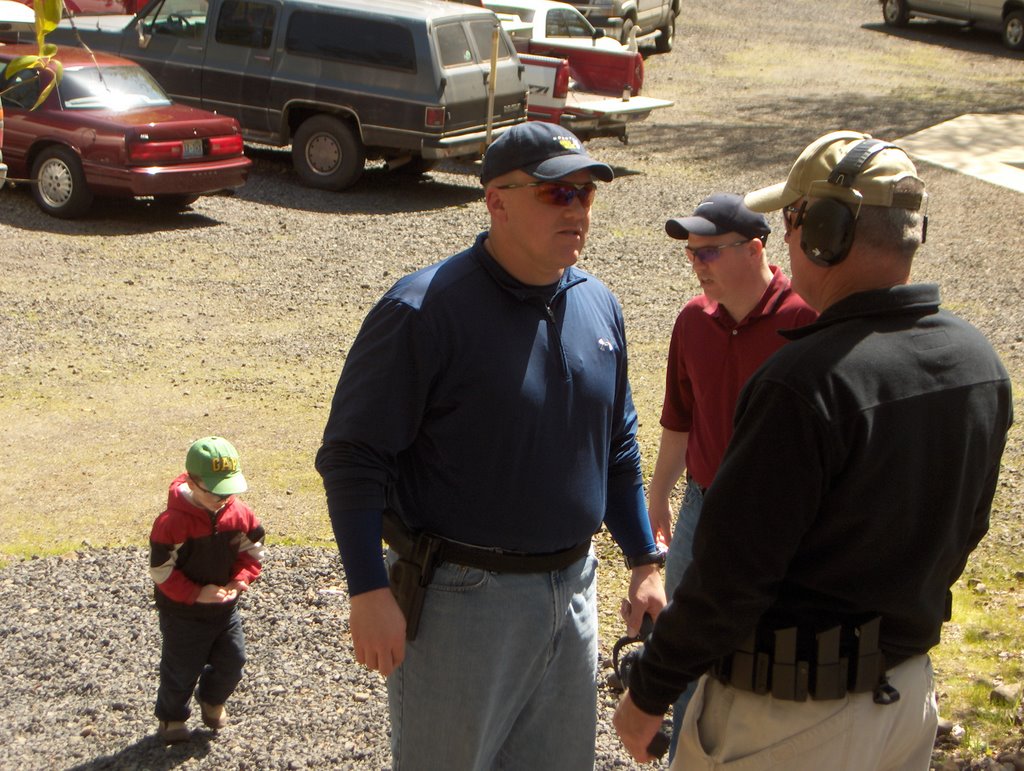
I would like to introduce you to some of the families I see at local shooting matches.

For example, the picture above was snapped at an IPSC match in April, just because of the curious juxtipositioning of TWO father-and-son pairs. That's right, the charming tot at the left of the picture is the son of the man in the red golf shirt (who is a supervisor at a local Private Security Company), and the man in the blue shirt is the son of the last man (who is a retired State Policeman and a part-time instructor at the Oregon State Police Academy.)


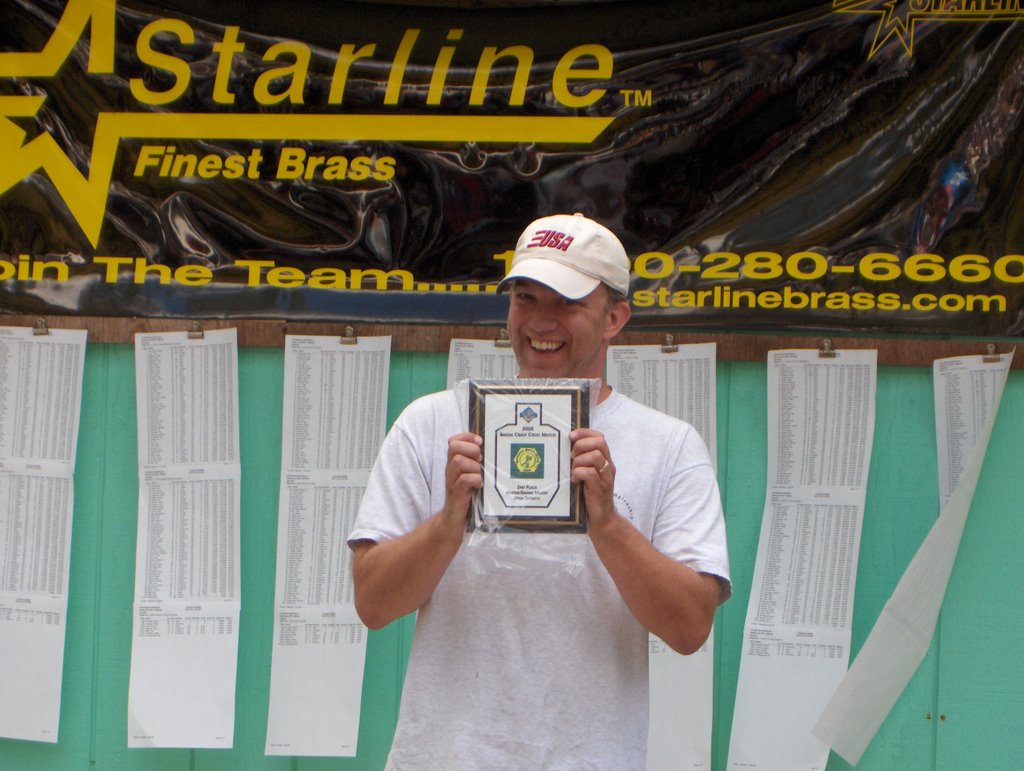
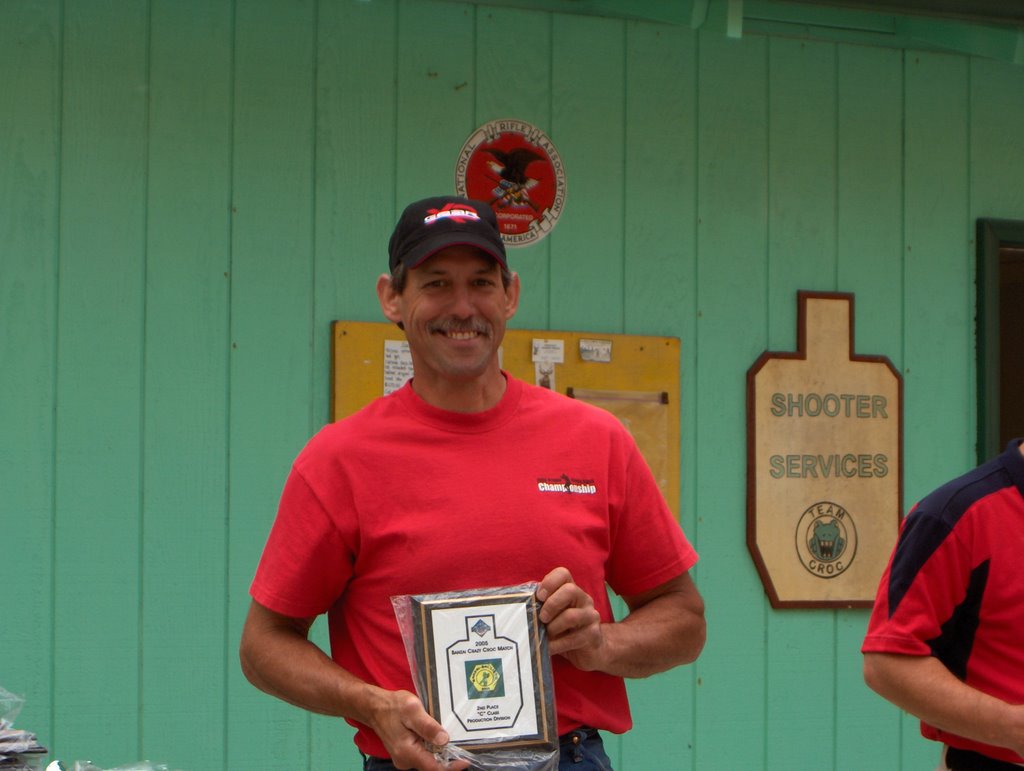
Take the 2005 Croc Match in Dundee, Oregon.

This is an unfortunately unflattering photo of Caryn, the High Lady at the match.

To the right is a much more flattering photo of her husband, Rob, who won Second Grandmaster at the same match.


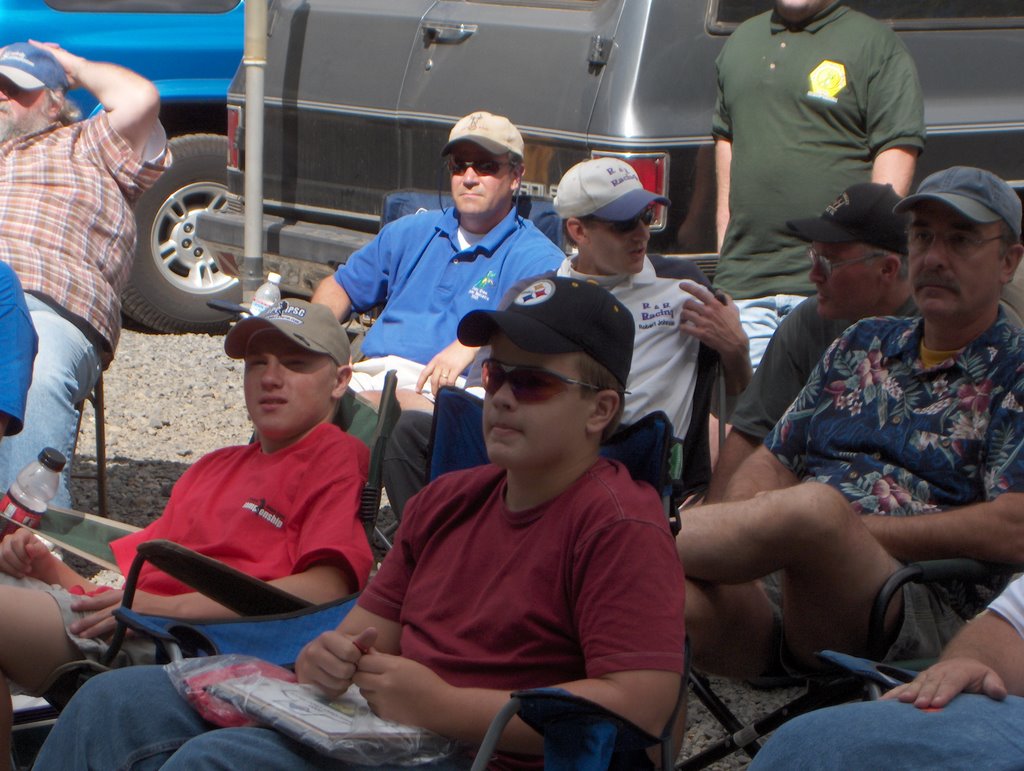
Wives show up at matches with their children. They even bring the family dog. Two of the four men in this photo brought either their wife or their son to the match.


And of course, it's not just the contestants who consider a shooting competition to be an appropriate place for their family. It's the match staff, as well.

Here, Match Director (and Section Coordinator) Mac McCarter is shown publicly thanking Loren and Sherrie, the husband-and-wife team which every year do NOT compete in the Croc Match. Instead, they design, construct and officiate on the "Jungle Run" stage which is the delight and the bane of IPSC competitors from all over America.

The Jungle Run is such a heart-stopping thrill to shoot, it's the primary reason why some people travel across multiple state lines to compete in this annual high-round-count event. This couple gets little enough recognition except for when Loren (an experienced Range Officer who once appeared on the cover of The Front Sight magazine) reads his incredibly unhelpful stage-procedure poem.

Still at the Croc Match Awards Ceremony, The Lovely Nancy (unfortunately caught with her back to the camera) and her husband "Pelican Bill" are shown in their matching green shirts.

Not the best pictures of The Pelican Family, perhaps, but those who were there can also pick out at least one father-and-son team, and one married couple in the picture.

Until I start to really LOOK at these random photos, it didn't occur to me how well they illustrated the pervasive influence of family participation at gun-games.

And of course, there are The Juniors.

These young people are the future of shooting competition.

The young man on the left/front (Drew), in the red shirt, is the grandson of Mac, the Section Coordinator of the Columbia Cascade Section.

The young man in the center/front (Zac) is the son of Norm The Ungrateful, one of the fastest-rising stars in the section. Zac made B-Open just before this match. Norm was bumped to Master two months ago. Norm has been shooting for just over three years; Zac just over two years.

And the young man in the background, with his head cut off just above the green collar of his Croc Match shirt? That's Stephan, subject of a couple of memorable videos which have graced this blog. He brought his grandfather out to watch him shoot.

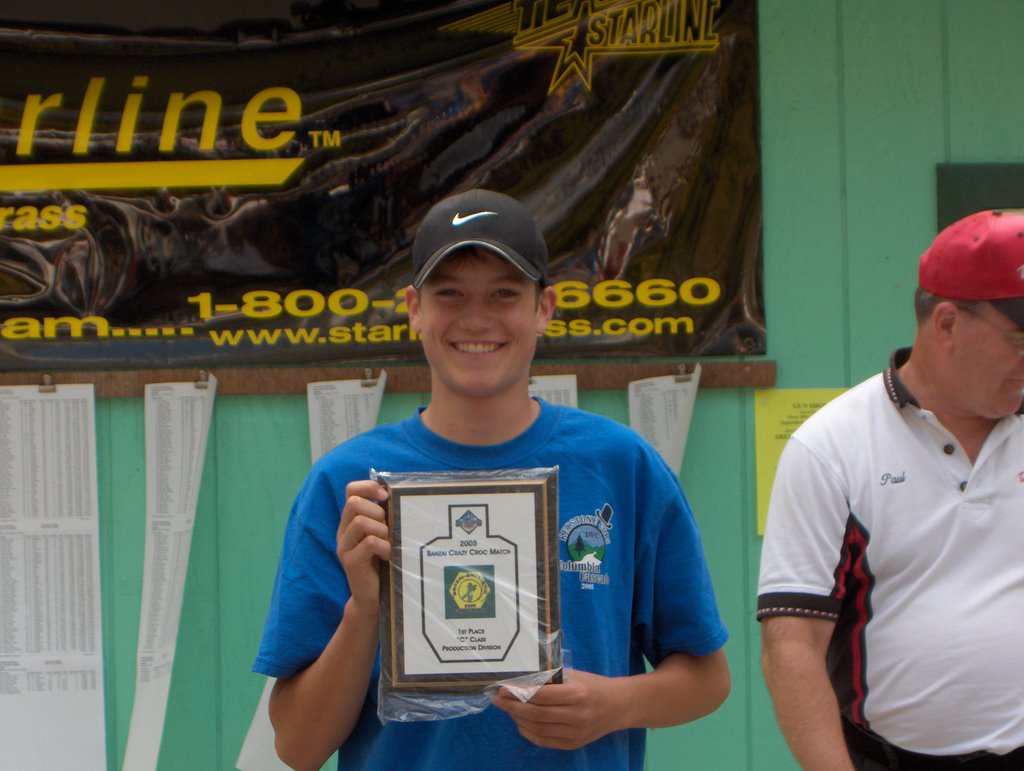
And there is Chris, whose father brought him to the Albany Rifle and Pistol Club a couple of years ago to join the Columbia Cascade Section Junior Program. Chris had so much fun shooting Production with a donated Glock 17 (as do most of the Juniors in this section) that his father, Jeff, just couldn't stand just watching anymore. Jeff got his own pistol, went through the certification course give by Mac at ARPC, and started shooting right alongside his son.


Chris (left) won First C-Production at the match.

Jeff (right) won Second C-Production.

You can bet that there was an interesting conversation on the ride home from that match. And you can also bet that Jeff was so proud of Chris that his own excellent finish was not the topic.


Finally, there is SWMBO and The Geek.

SWMBO (it stands for "She, Who Must Be Obeyed", from H. Ryder Haggard's novel "SHE!") spent the first two years of our relationship saying goodbye to me on Saturday Mornings as I left for weekly club match. I always invited her along, but SHE had been raised in a family which saw no use for guns.

One weekend SHE said "I can tell that if I'm going to see you more than half the time, I'm going to be in some crummy gravel pit. Wait a minute, I'll put my boots on. I'll meet you at the car."

She followed me around the range for three years, learning how to pick up brass and give it to the person whose gun had ejected it into the gravel. She learned the different calibers, how to distinguish them at a glance, and also learned that the people who went to these matches were a bunch of tail-gate-squatting, beer-swilling Rednecks. They were, in fact, people who were fun to know no matter what the venue. People she enjoyed spending time with.
Eventually, she said "I'm tired of always picking up other peoples' brass. Get me a gun. I want to shoot some cardboard!"

So I did, and she did, and she still picks up other peoples' brass. But they pick up hers, too.

(I think some of them are scared NOT to brass for her. She's an imposing figure, don't you think?)

Monday, May 01, 2006

USPSA to establish new relationship with IPSC

In a surprise move, the United States Practical Shooting Association (USPSA) Board of Directors (BOD) has taken one giant step forwards to establish new permissions for USPSA to compete under rules subtly different from those enacted by the International Practical Shooting Confederation (IPSC), while simultaneously forging a closer political bond with the International body.

IPSC publishes updates to its competitive rules in intervals ranging from three to five years. USPSA has typically taken exception to some of these rules, under the premise that the changes are either inapplicable to USPSA or that USPSA finds them administratively untenable given the more 'free-style' nature of USPSA competition or the U.S.A. Second Amendment "Right to Keep and Bear Arms" (RKBA) which more readily acknowledges American individual rights.

IPSC has always labored under a confusing morass of national law, especially since some Regions ... determined by National Laws ... prevent (for example) shooting at 'humanoid' targets or even the ownership or private storage of firearms.

While some American states or munincipalities impose restrictions on the storage or physical possession of firearms, there are few areas where firearms cannot be legally possessed without a minimum requirement of a license or other governmental permission. Also, there are no American areas which restrict the shape and nature of targets which can be shot at with firearms.

This implies a dramatic difference between the legal restriction among American States, and national laws in other parts of the world. While IPSC must cater to the 'least common denominator', at least in the sense of providing competition rules which allow participation by citizens of the most restrictive nation-states, the "least common denominator' bar is a bit higher in America ... generally concerned with magazine capacity and gun-safety tests (eg: California.)

IPSC even provides a 'non-humanoid' shaped target, which has found little acceptance in America .. the home of origin of "Practical Pistol" competition where the "Practical" use of a pistol has historically been assumed to be personal defense against a human aggressor.

The advantage to USPSA is that the BOD would no longer be required to negotiate with ISPC to determine which rules, often inadvantageous to USPSA, would be waived and which would be accepted ... albeit unwllingly on the part of the USPSA BOD.

The new relationship, as defined by the USPSA BOD, would allow USPSA to modify rules of competiton without the need to seek special permission (or "waiver") from IPSC to ignore rules intended to permit competition in countries which have legal restrictions not applicable to American law.

Further, it establishes the right of USPSA to sponsor firearms competition which is generally not supported by IPSC.

An example is 'multi-gun' matches, where three firearms (Rifle, Shotgun, Pistol) may be used in the course of a single stage. This is different from a "Three-Gun" match, where the same three types of firearms may be used but only one type of firearm may be used in a single stage.

Neither of these types of matches are currently officially sanctioned by IPSC. The new agreement would officially recognize a situation (multiple match types) which has ipso facto been sanctioned in USPSA for several years at a National level.

The BOD motion is included in toto, below. This is taken directly from the official BOD meeting minutes (The "Dallas"BOD meeting of March 3, 2006), as previously published by USPSA:

11:27 am

19: IPSC and USPSA-Planning for the future. Area 1 moves to pull off table.

Area 2 seconded.

Area 1 moves as follows:

Insofar as the International Practical Shooting Federation (IPSC) and its sole recognized affiliate for the United States region, The United States Practical Shooting Association (USPSA) share a common interest in promoting shooting competition, and;

Insofar as USPSA has historical, practical and reasonable needs to deviate in several and various ways from the IPSC rules for the conduct of shooting competitions within the United States, and has continuously maintained a long-standing precedent for doing so, and;

Insofar as neither IPSC nor USPSA desire to detrimentally affect their current affiliation, nor to detrimentally affect the image or operations of the other,

The Board of the United States Practical Shooting Association hereby declares its desire to resolve this issue in a manner that benefits the interests of both organizations, to wit:

?? The United States Practical Shooting Association will offer and promote IPSC competition within the United States, in accordance with IPSC rules, and in doing so fully satisfies its obligations under the IPSC constitution and affiliation agreement.

?? Separately, the United States Practical Shooting Association will offer and promote other forms of shooting competition within the United States, in accordance with such rules, policies and procedures as it deems appropriate, with specific details established by further action of the Board.

Because the United States Practical Shooting Association currently operates under an existing IPSC waiver granting authority for a United States rulebook, and because it is our mutual desire to minimize any disruption to competitors within the United States, it is reasonable and necessary for the IPSC Executive Council to approve our request for an extension of the current rulebook waiver through 12/31/2007.

This approach in no way represents a violation of the IPSC Constitution or the affiliation agreement currently in effect between USPSA and IPSC, and in fact represents a resolution to a long-standing conflict and a substantial growth opportunity for both organizations. Accordingly, the Board of the United States Practical Shooting Association directs its President, as the Regional Director for the US Region of IPSC, to communicate this direction to the IPSC Executive Council.

------------‑

Area 4 seconded. Passed

11:50 am

Area 1 moves for USPSA to make announcement release re: agenda item 19: IPSC and USPSA-Planning for the future,

Area 8 seconded.

Passed


This statement not only opens the door for USPSA to freely re-interpret rules according to American law and American values, but at the same time acknowledges IPSC as the ruling body of International Practical Shooting competition.

In other words, IPSC can do what it needs to do, for the benefit of regions outside the United States. At the same time, USPSA can do what IT needs to do, for the benefit of its 15,000 members, in competition within the United States.

In the meantime, USPSA will permit IPSC competition within its national boundaries based upon the 'pure' IPSC rules of competition. While nobody is obliged to attend these "IPSC-Only" matches, they can "vote with their feet" in regards to the degree of interest in 'pure' International Practical Pistol Competition.

This move is entirely in keeping with the democratic principles of American vigor, and establishes IPSC competitive rules as the root-stock of Practical Pistol competition.

Above all, it establishes a test-bed whereby the "IPSC vs USPSA" question can be settled for good, by the most rigorous and practial test possible, and at the same time preserves the vital relationship between IPSC and USPSA.

Sunday, April 30, 2006

Dillon Precision is OUR friend!

When I started adding "Resources I Recommend" to my sidebar, it somehow just didn't occur to me to include Dillon Precision to the mix although I can't think of a single 'resource' which is MORE intrinsic to IPSC competition in the US.

In fact, even though I cited Dillon as a new source of the previously 'unobtanium-rated' Gargantuan Gunsite Gossip books, I remained blissfully clueless about the need to provide an easy-access link, or to reinforce the legendary "No Bullshit" Dillon Guarantee.

Okay, these Scottsdale Suppliers are much to dignified to give their guarantee the name which best describes it, but it's true. If you have a problem with anything you buy from Dillon, even if it's not something they build themselves, they'll make it right for you no matter what it costs ... to them. It won't cost YOU anything, except possibly shipping charges to return the item in question.

If you're a Dillon customer, you have already read the many testimonials in their monthly catalog. The ones that come to the front of mine are the 550 (Square Deal, whatever) loading presses that were damaged by user neglect, misfortune, accident or nobody's fault and returned with the hope that Dillon would consent to repair it and charge the customer for parts and labor ... but were instead either completely refurbished OR REPLACED at no charge to the customer.

Dillon calls it the "No Fault" or "No Hassle" warranty, but you know in your heart that it's the No Bullshit Warranty.

This is tacit acceptance that they only stock the best, they only ship the best, and if there's anything wrong you don't have to deal with weasel-words such as "please contact the original manufacturer and provide proof of ownership" ... if you bought it from Dillon, it's repaired or replaced by Dillon, even if you are the Dork that broke it by misuse or misadventure.

Example: over ten years ago, I managed to crunch a primer in my XL650 while loading 9mm ammunition. The primer exploded, as did a few others in the primer column. No damage to me or mine, but the charge shot the plastic primer-follower rod into the ceiling, and the pieces that I DID find were twisted like a corkscrew.

I called Dillon to ask for replacement parts.

The said I had a 'obsolete design' of the primer-feed assembly, lacking the safety features of current releases. (The press was about 5 years old at the time.) They sent an entire new-design primer assembly, with instructions on how to install it, and asked only that I return the old primer assembly to insure that it would never be used by another unsuspecting customer.

Price to me: the phone call ... and it was a 1-800 number which means it didn't cost me a cent. And they shipped it to me by air express, no charge for expedited shipping. Dillon understands that we often wait until the last minute to reload for an IPSC match, and we NEED to get our loading press back online quickly.

--

The incident that prompted this unsolicited testimonial, however, is much more recent.

Last week I wrote that I discovered Col. Jeff Cooper's "Gargantuan Gunsite Gossip" (Volume 1) was available directly from Dillon. Not only that, but Volume II was also available. This was Good News to me, because I had lost my Volume I in a burglary some years ago, and I had only read it once. The best prices I could find on Amazon.com were totally unacceptable. Current offerings ... one at $95.27 and another at $199.00!) Dillon had Volume I listed at $29.95 and VOlume II listed at $39.95. I ordered one copy of each the same night as the original post!

They had them in stock, too, and I received my book order within five business days.

The only problem was, instead of receiving one copy of each, I received two copies of Volume II.

Arrggghh!

I went to the Dillon website, found the 'contact us' email address, and explained my problem. I offered to return the extra copy of the book if they would give me a "Return Merchandise Authorization Number" (RMA) so I would get credit. I cited the invoice number, which clearly indicated that I should receive one of each volume, and also included my Customer Number, my name, address and telephone number.

Not reply from email, no phone calls. For three days I was curious about whether Dillon actually monitored their "contact us" traffic.

Then, on the third business day (last Friday), I received a shipment from Dillon.

Inside was Col. Jeff Cooper's "Gargantuan Gunsite Gossip: Volume I" in it's familiar blue binding. Also, an invoice with "no charge", a shippping label made out to Dillon's "RETURNS" department, and a pre-paid postage label for $8.50 ... the Parcel Post rate, not the "Books" rate.

Five minutes after I got home and opened the box, I had put the superfluous copy of GGG II into the box, written "You Done Good, Guys!" on the invoice and laid it on the GGG II copy, replaced the packing, sealed the box and affixed the address label and supplied postage to the outside. Saturday Morning I went to the post office and explained that I was not shipping a bomb but returning a book (the post office is very particular about the big, heavy boxes they ship now-days) and was assurred that it should arrive at its destination in five business days.

Cause of the shipping error: clearly Dillons.

Expenses incurred: entirely Dillons.

Credit for making good on a simple, common slip: entirely Dillons!

With any other vendor, I would have had to prove everything, and they wouldn't have shipped the correct volume until they had received the superfluous copy. Not Dillon. They didn't ask any questions, they assumed I was an honest man and a valued customer, and did what was necessary to make it right with a minimum of paperwork, delay and complication.

Heck, I could have kept the extra copy of GGG II and sold it on Ebay, to my advantage.

But I AM an honest man, and I DO value my given word.

The same can be said of Dillon Precision.

It's amazing how simple Trade can be, when all parties assume each other to be operating on the Good Faith Principle.

Bottom line: if you need a thing, and you can get it from Dillon or you can get it from some other vendor -- buy from Dillon. You will never regret it. In seventeen years of buying both via phone and via the internet, I have never regretted it.

You have The Geek's word on it.

And more important, you have Dillon's word for it.

Take it to the bank.

Thursday, April 27, 2006

Steel Is My Friend

Steel targets can be intimidating when you're shooting an IPSC match. Some competitors are daunted when presented with a steel-target array (plates, US poppers, Pepper Poppers) and, conscious of the inexorable movement of the clock, shoot too fast ... and miss.

Steel targets are smaller than IPSC targets. You don't get to hose them down, because there is no chance of getting a 'near miss' that counts. You either hit the A-zone, or you don't. When you miss the A-zone on a steel target, you get no credit. Your only choice is to eat the miss, or make up the shot.

Two years ago, SWMBO was uncomfortable with shooting Steel targets. Our friend Randomly Hittin' Witten and I took her to the range and spend a few hours shooting at steel-only stages. The theme was "Steel Is My Friend" ... because when you hit a steel target, it's reactive and you know if you hit it or not. The lesson: slow down (and get the hits) to shoot fast.

Fast-forward to the Dundee club match in April, 2006. This was a classifier match, but there were two non-classifier stages presented as well, for variety. The classifiers were 'technical stages', and generally not as exciting as one might wish. They tested for pinpoint accuracy, reloading, strong-hand / weak-hand shooting and shooting from an awkward position. These are all of the skills we must master to be competitive, but they are B-O-R-I-N-G!

Of the two 'fun stages', perhaps the most challenging was the Steel stage.

Picture this:

Start from a position where you can't see the targets, draw and run to the first shooting position.
Arriving out of breath and off-balance, you shoot at;
A plate rack with six 8" plates, plus two freestanding 8" plates and a US popper on the ground.

Move to another shooting position, where you can see a six-target array of US Poppers (very small) arranged like pins in a bowling alley, with a wide index to pick up another 8" plate which is hidden behind a barrel from any other position.

Transition to a final position, where you can (with some body-language movement between targets) engage a final 8" plate, two more US poppers and a final Pepper Popper.

She did everything exactly right. Didn't hurry, got a good sight picture on every target, took some chances by shooting on the move and cleaned the stage. She ended up 15th overall on the 20-round stage for the match (stage #6: Speedy Steel). And what's more, she did it with a borrowed gun.


To musically accompany this video, I've chosen "Witchy Woman" by the Eagles, if only for the line:

"Raven Hair,
And Ruby Lips,
Sparks fly from her fingertips"
Somehow, it seemed to fit.

Bang. Clang!

(Thanx to Caryn S. for the video!)

Monday, April 24, 2006

Shooter strips to raise funds

Shooter strips to raise funds - Aftenposten.no

Aftenpost, the Norwegian online newspaper, is one of my favorite online sources of bizarre news, challenged only by the WaiWai section of Japan's Mainichi Daily News.

They don't promote themselves as a source of Strange News, Aftenposten doesn't seem to have any problems finding odd people doing odd things.

Case in point: a candidate for the Norwegian National Olympic Shooting Team has found an unusual way to finance this trip to Beijing.

Are Hansen seems to be shooting from the hip, quite literally. The 24-year-old shooting champion has taken to posing naked, with his rifle strategically held, in a quest to raise funds needed for competition.

Hansen is quick to reveal the naked truth behind his unorthodox move: He needs money if he hopes to be able to compete in the next Olympics in Beijing.

He hopes that posing naked for all but his guns and medals, and then selling the photos, will attract some attention and some funds. The main problem is that the Norwegian shooters' association (Norges Shytterforbund) has no main sponsor, and that means those taking part in international competition need to bear a lot of the expense themselves.

Free Image Hosting at www.ImageShack.us

Hansen, for example, took part in the World Cup opening in China in March, made it to the finals and ended in eight place. But it was an expensive presentation. "We had to pay half the tour ourselves, and for me, that amounted to NOK 10,000," he said.

That's a lot of money for the engineering student who lives in Sarpsborg. Hansen doesn't mean to be firing away at Norway's Olympic committee, but he'd hoped his good results would have attracted more funding. He does have a NOK 50,000 grant from the committee, but that only covers his weapons and ammunition.

"We simply can't afford to send out all the shooters who qualify," admits national shooting coach Christian Lilleng. Even when Norway has never had so many good shooters as it does now.

In the meantime, Hansen figures the shooting season will cost him around NOK 150,000, and that uncovering himself may help him cover his expenses.


It's hard to predict whether Hansen can generate sufficient interest to finance his trip, but nobody can't question that he is highly motivated.

This is a young man who really REALLY wants to compete. I admire his determination, and when I compare it to my own personal indicision about shooting the ARPC Single Stack Championship, Columbia Cascade Sectional Tournament, The Croc Match and USPSA's Area One Tournament (all held in Oregon over the 2006 USPSA Shooting Season, and all 'lost-brass' matches) because of the expense, I would be the first to admit that my own dedication does not stand comparison.

Here's an offer: Send money. For every match that is fully funded by public donations, Jerry the Geek will NOT walk naked through the range protected from the sight of revolted onlookers only by an STI Open Pistol.

While a mere Derringer is sufficient bulk to conceal The Geek's "ultimate privacy", the rest isn't all that appealing, either. [shudder!]

Send your checks to Jerry the Geek, 1 Main Street, Geekistan, Oregon.

To paraphrase Cleavon Little in Blazing Saddles; "Everybody gives, or the Geek shows it!"

Wednesday, April 19, 2006

IPSC: STI TruSight accepted in USPSA Limited Division

Free Image Hosting at www.ImageShack.usDave Skinner, President and CEO of STI, Inc. (Georgetown, Texas) announced yesterday that the STI TriSight has completed a production run of 500 guns and, upon application, has been accepted by the United States Practical Shooting Association (USPSA) as legal for competition within the United States in Limited Division.

The pistol ( MSRP $1,984.40) is available in 9mm, .40 S&W, and .45 ACP calibers.

Free Image Hosting at www.ImageShack.usThe salient feature of this new model varient of the venerable STI EDGE is that the front sight is mounted on the barrel, not on the slide, providing (according to STI) a faster slide cycling time with its lighter 4-1/2" slide and a faster sight-pickup.

The pistol weighs in at 36.1 ounces, which makes it lighter, STI claims, than " pistols comparable to it in its class."

Free Image Hosting at www.ImageShack.usThe STI Edge, which is another (and older design) full-dust-cover pistol, weighs 39.0 ounces and is available (MSRP $1,874.00) in not only the same 9mm, .40S&W, .45ACP calibers but also in .38 super. It was also available in 10mm, because I bought the first 10mm STI Edge in 2000, when it was similarly declared "IPSC Legal" by USPSA. I suspect that the greater weight is provided by the longer dust-cover on the Edge, assuming the overall barrel length (including "Expansion Chamber", on the TruSight) is the same.


Free Image Hosting at www.ImageShack.usThe TruSight is controversial in USPSA circles (especially the "Unofficial IPSC List") because the addition to the muzzle is actually an 'expansion chamber', 0.100" larger than the bore. Whether this provides any actual competitive advantage is yet to be seen, because field tests are not yet available.

The controversy is provided free-of-charge by the "expansion chamber", which is the large extrusion on the muzzle-end of the barrel (shown above). Because it is bored out slightly larger than the barrel diameter (and the diameter of the exit port, which is supposedly the same or nearly the same diameter as the barrel), some critics have suggested that it is a "compensator", allowing expansion of exhaust gasses and therefore softening the recoil. The argument is that the "expansion chamber", they claim, provides a distinct and signifigant advantage in that it uses the exhaust gasses to either lessen the perceived recoil, or muzzle-flip; which, or what, is not clear.

Since this is an entirely new innovation, and none of the critics have had the opportunity to actually fire the TruSight, all of the commentary so far available has been limited to supposition and expostulation ... not empirical measurement.

Had either the International Practical Shooting Confederation (IPSC) or USPSA bothered to define a 'compensator', there might be some grounds for objection to this design in Limited Class ... which specifically outlaws 'compensators'. Unfortunately for the detractors, the term can only be defined in 'traditional' terms which include the presence of an 'exhaust port'; clearly absent in the current design.

Because the 'expansion chamber' has removed metal from the front of the pistol, the exclusion based upon "added weight" is obviated.

And while the current USPSA rule book forbids "modifications" to the pistol, for various reasons, this is a feature of a production gun (500 guns having been manufactured, and so certified by the manufacturer). This is clearly not a 'modification' but a salient feature of a production gun.

Finally, USPSA has officially approved it, which renders all objections moot.

We don't know whether it SHOULD have been approved (although our evaluation, based purely on the specifications and the published rule book do not contradict the decision of the USPA Board of Directors), and we certainly have not the means or opportunity to objectively determine whether it provides a competitive advantage in Limited Division by virtue of reduced recoil or muzzle-flip. But one thing is clear:

The STI TruSight IS USPSA Legal in Limited Division.

It's a done deal.

If you think you can profit competitively by buying and using an STI TruSight, the door is wide open.

Go for it.

UPDATE: April 20, 2006
Check the comments for extended discussion on the subject of "Competitive Advantage" vs legality of 'the device' in a Limited Division pistol.

Tuesday, April 18, 2006

Gargantuan Gunsite Gossip

Amazon.com: The Gargantuan Gunsite Gossip: Books: Jeff Cooper
Image Hosted by ImageShack.usSome time ago, I mentioned that I was on the lookout for a replacement of Jeff Cooper's "Gargantuan Gunsite Gossip".

This was ... and is ... a collection of his writings for Cooper's Corner, which I believe was a regular one- or two-page feature of Guns & Ammo Magazine.

Memory fades with age, but I believe that it was eventually discontinued because The Colonel's Commentary was just too controversial and outspoken to be acceptable in a Politically Correct world. Jeff Cooper had the disconcerting habit of saying what he thought, and after trying to 'fix' the problem with disclaimers, the magazine eventually discontinued the column.

Today, you can still read Cooper's Commentaries on the 'net, but you have to be very patient as it only comes out once a month. That wasn't a particular hardship when it was being published in a monthly magazine, but when you're surfing the net you tend to become ... impatient.

As I say, my copy of The Gargantuan Gunsite Gossip was stolen from my car by some loonies who took the book, but left a thousand rounds of 10mm ammunition in the back. Either they were discriminating readers, or they had no inclination to pack 20 pounds of full ammo-can as they ran from the parking lot. Frankly, I had rather they stole the ammo and left the book. I can always replace the ammo, but the book was priced between $100 and $200 on the internet, almost regardless of the condition. (Current prices on Amazon, see the link at the top, START at $95.)

When I received my May, 2006, Dillon Precision catalog the other day, I was startled to find they had copies available for $29.95!

I'm still in shock, but I'll be buying a copy real-soon-now, you betcha, along with a few other items I need (9mm/38super cartridge boxes, de-capping pins for the XL650 ... I'm down to 3 since I ran into a handful of berdan-primed 9mm Largo brass in my range-gleanings.)

Image Hosted by ImageShack.usWhile I'm at it, I might as well plunk down another $40 and buy The Gargantuan Gunsite Gossip 2 ("covers years 1990 - 2000).

I know I'm going to want it, and maybe I can throw away the set of dusty hard-cover printouts from the website that I've been hanging on to re-read.

I already have "To Ride ...", so I don't need to buy that. I may wait for a while before I get "Another Country". And I'm not interested in "Art of the Rifle". I've pretty much exhausted my interest in hunting and rifle shooting.

I feel like a kid at Christmas. I didn't see this one coming, I never expected another publishing run on this fine American Shooter (not to be confused with the tv show) book. It's to the credit of Dillon Precision that they did whatever they did to get this either republished, or find a forgotten cache of original 1989 copies.

This is about 1200 pages of 6" x 9.2" x 1.5" Americana, and I heartily recommend it. But don't buy it until I get my copy, okay? Because if you buy the book, and it's out of stock when my order gets in, and you live in the Pacific NorthWet, I'll be begging you to lend me the book until you finally wilt.

Note: If you go to the Amazon.com link, you'll find my September 19, 2005, comments. I begged people to give up their copy for the sake of The Geek, but I never got any response.

Those Amazonians are a heartless crew.

UPDATE: I've just placed my order, online, for The Gargantuan Gunsite Gossip and The Gargantuan Gunsite Gossip 2, through Dillon Precision. Feel free to order as many copies as you wish. And if you don't get one because it's already sold out, don't come crying to me. I've got mine!